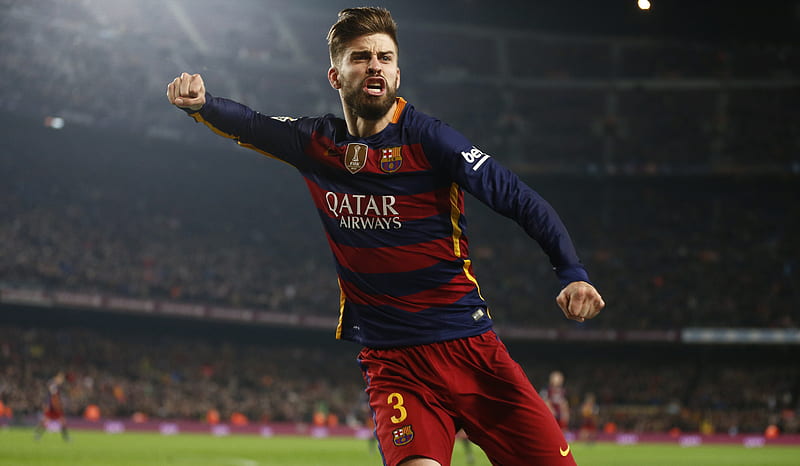
1. Grassroots Origins, Physical Gift & Formative Athletic Years
Gerard Piqué Bernabeu was born on February 2, 1987, in Barcelona, Catalonia, Spain, into a family deeply embedded in Catalan identity and elite football culture. His father, Joan Piqué, achieved substantial commercial success as a corporate lawyer and businessman, while his mother, Dr. Montserrat Bernabeu, earned widespread acclaim as the director of a prestigious spinal injuries hospital in Barcelona. Most significantly, football heritage ran in his bloodstream through his maternal grandfather, Amador Bernabéu, who served for decades as a high-ranking director and vice-president of FC Barcelona. On the very day Gerard was born, his grandfather registered him as an official socio (member) of FC Barcelona, establishing an unbreakable lifelong connection between the child and the institution.
Growing up alongside his younger brother Marc in a wealthy district of Barcelona, Piqué combined intense physical athleticism with rare intellectual precocity. He enrolled in FC Barcelona’s world-renowned youth academy, La Masia, in 1997 at the age of ten. Immersed in the club’s famed Tiki-Taka philosophy—conceived by Johan Cruyff—Piqué initially honed his skills as a defensive midfielder. His remarkable vision, aerial dominant height, and composure under pressing pressure allowed him to orchestrate play from deep positions. Alongside prodigies such as Cesc Fàbregas and Lionel Messi, Piqué formed part of the legendary Generació del 87, a youth side that dominated domestic junior tournaments and set unprecedented records across Spain.
However, as Piqué approached his late teens, contractual complexities within Spanish sports law presented a dilemma. Under Spanish regulations, academy players could not sign professional contracts until turning eighteen, leaving them vulnerable to foreign clubs offering immediate professional terms. Recognizing the teenager’s physical gift and tactical flexibility, Sir Alex Ferguson and Manchester United made a direct approach. In the summer of 2004, seventeen-year-old Piqué made the bold strategic decision to depart his boyhood club and move to the North West of England to finalize his professional transition under Ferguson’s mentorship.

2. Stepping into the Arena: Early Career Milestones & Rising Stardom
Arrival at Old Trafford provided Piqué with a baptism by fire in the physical, relentless environment of English football. He made his senior debut for Manchester United on October 26, 2004, coming on as a 67th-minute substitute for John O’Shea during a 3–0 League Cup victory against Crewe Alexandra. Over the next two seasons, Piqué shuttled between United’s elite reserve squad and first-team cup fixtures, showcasing a unique hybrid style that blended Spanish technique with Premier League physical durability. He signed his first major professional contract extension in February 2005, earning high praise from Ferguson for his distribution out of defense.
To accelerate his tactical maturation, Manchester United sanctioned a season-long loan to La Liga club Real Zaragoza for the 2006–07 campaign. The move proved to be the pivotal catalyst of Piqué’s development. Operating at both centre-back and defensive midfield alongside Argentine international Gabriel Milito, Piqué made 22 first-team appearances and scored two goals. His commanding defensive displays helped Zaragoza finish sixth in La Liga and secure UEFA Cup qualification, proving beyond doubt that he possessed the composure and positional sense required to thrive at the absolute peak of European football.
Piqué returned to Old Trafford for the 2007–08 season, fully integrated into a squad that would establish European dominance. On November 7, 2007, he made his home UEFA Champions League debut, opening the scoring with a soaring header in a 4–0 victory over Dynamo Kyiv, becoming the 450th player to score for Manchester United. He added a second European goal away against AS Roma a month later. By the conclusion of the 2007–08 season, Piqué had earned Premier League and UEFA Champions League winner’s medals. However, with Nemanja Vidić and Rio Ferdinand firmly established as Ferguson’s preferred central defensive duo, Piqué yearned for guaranteed starting minutes at his spiritual home. In May 2008, newly appointed FC Barcelona manager Pep Guardiola identified Piqué as the tactical cornerstone of his structural revolution, repurchasing the defender for a fee of €5 million.
3. Career Longevity, Historic Tournaments & Unmatched Dominance
3.1. Defining Championship Matches & Decisive Victories
Piqué’s return to FC Barcelona in the summer of 2008 triggered one of the most remarkable single-season transformations in football history. Guardiola immediately installed Piqué at the heart of Barcelona’s defense alongside club captain Carles Puyol. The pairing was instantly complementary: Puyol brought relentless intensity, physical tackling, and defensive leadership, while Piqué provided serene positional reading, pinpoint long-range passing, and smooth ball transport into midfield. Piqué’s ability to act as a ‘Piquebauer’ (a nod to Franz Beckenbauer) completely altered how modern teams built attacks from the back line.
The 2008–09 historic treble campaign saw Piqué elevate his performances to world-class standards. On May 2, 2009, he etched his name into Blaugrana folklore during the iconic El Clásico at the Santiago Bernabéu, scoring the final goal in a historic 6–2 destruction of Real Madrid and celebrating passionately in front of the away supporters. Weeks later, on May 27, 2009, Piqué started in the UEFA Champions League final in Rome against his former club Manchester United, keeping a clean sheet in a 2–0 victory. In doing so, Piqué became one of only four players in history to win back-to-back Champions League titles with different clubs. FC Barcelona concluded 2009 by capturing an unprecedented six trophies in a single calendar year: La Liga, Copa del Rey, UEFA Champions League, Supercopa de España, UEFA Super Cup, and the FIFA Club World Cup.

3.2. International Stature & Dominance on the World Stage
Following his club triumphs, Piqué became the defensive bedrock of the Spanish national team during its immortal international dominance. At the 2010 FIFA World Cup in South Africa, national coach Vicente del Bosque partnered Piqué with Puyol once again. Piqué played every single minute of Spain’s seven tournament matches, suffering a severe facial cut in the group stage but heroically battling through. Spain conceded just two goals throughout the entire tournament and kept four consecutive clean sheets in the knockout stages, culminating in a 1–0 extra-time victory against the Netherlands in the final to lift Spain’s first World Cup trophy.
Two years later, Piqué reached the absolute pinnacle of defensive mastery at UEFA Euro 2012. Partnered with Sergio Ramos in central defense following Puyol’s injury, the duo established an impenetrable barrier. Spain allowed just one goal across six matches, completely neutralizing Italy 4–0 in the final to retain the European championship. Piqué was named to the UEFA Team of the Tournament, solidifying his status as the premier ball-playing centre-back on the planet.
At club level, Piqué reached another career zenith during the 2014–15 season under manager Luis Enrique. Forming a terrifyingly efficient unit alongside Javier Mascherano and behind the unstoppable attacking trio of Lionel Messi, Luis Suárez, and Neymar (MSN), Piqué powered Barcelona to their second historical treble. On June 6, 2015, Barcelona defeated Juventus 3–1 in the Champions League final in Berlin, earning Piqué his third Champions League crown with Barcelona and fourth overall.

3.3. All-Time Great Stature & Athletic Milestones
As the years progressed, Piqué evolved from a high-energy sweeping defender into an authoritative tactical general and locker-room spokesman. His deep tactical intellect compensated for any gradual loss of raw pace, relying on elite positioning, aerial dominance, and surgical tackling. Following Puyol’s retirement and the departures of Andrés Iniesta and Xavi Hernández, Piqué was named one of FC Barcelona’s official club captains in 2018, serving as a fierce defender of the club’s socio-political stance and sporting values.
Piqué retired from international football in August 2018 having earned 102 caps and scored 5 goals for Spain, solidifying his legacy in the international centurion club. At FC Barcelona, his career reached incredible longevity: he surpassed 600 official appearances for the club in March 2022, placing him fifth on Barcelona’s all-time appearance list. Over his extraordinary playing career, Piqué collected an eye-watering array of honors: 37 total official trophies, including 8 La Liga titles, 7 Copas del Rey, 3 UEFA Champions Leagues (with Barcelona), 1 Premier League, 1 UEFA Champions League (with Manchester United), 1 FIFA World Cup, and 1 UEFA European Championship. Individually, he earned four selections to the FIFA FIFPro World11 and five selections to the UEFA Team of the Year.
On November 3, 2022, Piqué stunned the footballing world by announcing his sudden retirement from professional football in an emotional video addressed to the fans. He played his final official match at the Camp Nou on November 5, 2022, against Almería, receiving a massive standing ovation from over 92,000 spectators as he delivered an emotional farewell speech promising a future return to the club in an administrative capacity.
4. Behind the Champion: Private Passions, Relationships & Family Ties
Gerard Piqué’s personal life has consistently generated intense global public interest, driven by his natural charisma, aristocratic Catalan heritage, and high-profile romantic relationships. In the spring of 2010, while filming the official music video for the 2010 FIFA World Cup anthem “Waka Waka (This Time for Africa),” Piqué met global Colombian pop superstar Shakira. Despite sharing the exact same birthdate—February 2, though Shakira is ten years his senior—the two struck up an immediate dynamic connection. Their romantic relationship was officially confirmed in early 2011, quickly becoming one of the world’s premier celebrity power couples, frequently dubbed ‘Piquebér’ by global media.
The couple established their primary family residence in Barcelona and expanded their family with two sons: Milan Piqué Mebarak, born on January 22, 2013, and Sasha Piqué Mebarak, born on January 29, 2015. Despite their twelve-year partnership and shared business investments, Piqué and Shakira intentionally chose never to marry, publicly stating that they preferred to keep their dynamic fresh without legal paperwork. Throughout their time together, the family lived a highly publicized life, attending international awards galas, tennis tournaments, and Barcelona matches.
In June 2022, after months of intense media speculation, Piqué and Shakira issued a joint public statement confirming their formal separation. The breakup escalated into an unprecedented global tabloid frenzy. Following an arduous custody dispute, an agreement was finalized allowing Shakira to relocate with their two sons to Miami, Florida, in early 2023, while Piqué retained extensive visitation rights. Shortly after the separation, Piqué went public with his relationship with Clara Chía Martí, a Spanish public relations student working for his sports media group, Kosmos Holding. Their relationship remains the subject of relentless international media coverage and paparazzi focus.
5. Career-Threatening Injuries, Sporting Feuds & Overcoming Adversity
5.1. Kosmos Holding, RFEF Supercopa de España Deal & Anti-Corruption Inquiries
Beyond his sporting brilliance, Piqué’s aggressive business expansion through his investment firm Kosmos Holding has embroiled him in high-stakes financial and legal controversies. The most severe incident broke in April 2022, when leaked audio files and documents published by Spanish media revealed that Kosmos had negotiated a multi-million-euro commission deal with the Royal Spanish Football Federation (RFEF), headed by then-president Luis Rubiales. The deal successfully brokered the relocation of the expanded Supercopa de España (Spanish Super Cup) tournament to Saudi Arabia in exchange for an estimated €40 million in total commissions paid to Kosmos over a six-year period.
The disclosure sparked immense ethical outrage across international football, with critics highlighting an inherent conflict of interest in an active FC Barcelona player negotiating financial deals involving the national federation and competing clubs. Piqué held an emergency press conference on Twitch, passionately defending the deal as fully transparent, legal, and beneficial for Spanish football’s grassroots funding. However, the legal fallout deepened significantly. In May 2024, a Spanish investigative court formally named Piqué as an official subject under criminal investigation for alleged corruption, business bribery, and money laundering related to the Saudi contract. Piqué maintained his innocence, asserting that all financial transactions were vetted by top-tier legal counsel and carried out ethically.
5.2. The BZRP Music Sessions #53 Fallout & Media Storms
Simultaneously, Piqué faced a fierce public relations storm surrounding his personal life. Following their 2022 breakup, Shakira released a series of globally explosive diss tracks in collaboration with Argentine producer Bizarrap, titled “BZRP Music Sessions, Vol. 53,” alongside tracks like “TQG”. The lyrics directly targeted Piqué and his new partner Clara Chía, featuring viral lines comparing the trade-off to exchanging a Ferrari for a Renault Twingo and a Rolex for a Casio watch. The song smashed global streaming records, topping charts across Spotify and YouTube.
Rather than retreating from the media storm, Piqué leveraged the viral frenzy with characteristic boldness. Days after the song’s release, Piqué arrived at a Kings League event driving a white Renault Twingo and announced a commercial sponsorship deal between Casio and his new sports league. While his rebellious response delighted core fans, it further ignited media debates around celebrity rivalries, brand management, and public image. Additionally, Piqué faced years of tax scrutiny in Spain; in July 2019, Spain’s High Court ordered him to pay €2.1 million in back taxes and fines related to the alleged improper transfer of image rights to his family firm between 2008 and 2010.
6. Nutrition, Brand Ambassadorships & Sporting Influence
Gerard Piqué has consistently stood out from typical professional athletes due to his sharp intellect, outspoken political opinions, and digital savvy. Possessing an estimated IQ of 140, Piqué pursued executive education during his active playing career, completing a prestigious business course at Harvard Business School under Professor Anita Elberse in 2017. His fashion style seamlessly bridges classic European tailoring with modern high-street luxury, frequently featuring tailored suits, minimalistic street design, and high-end watches.
On social media, Piqué commands a massive digital footprint, boasting tens of millions of followers across Instagram, X (formerly Twitter), and Facebook. Unlike many PR-managed athletes, Piqué has historically authored his own social media posts, using platforms to directly challenge sports media narratives, debate opponents, and launch business initiatives. His willingness to speak candidly on controversial issues—including his vocal support for the Catalan independence referendum in 2017—frequently made him a divisive figure when playing away matches for the Spanish national team, where he was routinely whistled by domestic crowds. Yet, his unwavering authenticity cemented his icon status among Catalan faithful.
7. Current Season Campaigns, Title Defense & Future Ambitions
Since hanging up his boots in late 2022, Piqué has fully transitioned into a pioneer of contemporary sports entertainment. As president and founder of Kosmos Holding, he oversaw the radical transformation of the historic Davis Cup in international tennis under a multi-billion-dollar partnership with the International Tennis Federation. Although that partnership concluded in early 2023, Kosmos has expanded aggressively into football club ownership, holding majority stakes in FC Andorra—which Piqué elevated from regional leagues to Spanish professional football—and Gimnàstic Manresa.
Piqué’s crowning post-retirement achievement is the creation of the Kings League, launched in late 2022 alongside premier Spanish Twitch streamer Ibai Llanos. The Kings League is a revolutionary 7-a-side football tournament featuring modified dynamic rules (such as secret wildcards, liquid countdown clocks, and shootout penalties) owned by prominent internet content creators and retired football legends like Iker Casillas and Ronaldinho. The league became a viral global sensation, drawing over one million concurrent digital viewers on Twitch and packing out the Spotify Camp Nou with 92,000 fans for its inaugural final four event. Piqué has subsequently expanded the franchise internationally, launching the Kings League Americas and announcing global World Cup expansion tournaments, solidifying his status as a visionary media executive reshaping the future of sports broadcasting for younger generations.
Gerard Piqué Bernabeu FAQs: Key Questions Answered
How old is Gerard Piqué?
Gerard Piqué was born on February 2, 1987, making him 39 years old.
Who is Gerard Piqué dating or married to?
Gerard Piqué is currently unmarried and in a committed relationship with Spanish public relations professional Clara Chía Martí. He was previously in a twelve-year relationship with Colombian singer Shakira from 2010 until their separation in June 2022.
What is Gerard Piqué’s most famous work?
Gerard Piqué is most famous for his legendary career as a world-class centre-back for FC Barcelona and the Spanish national team, winning 37 major trophies including the 2010 FIFA World Cup, UEFA Euro 2012, and four UEFA Champions League titles. In his post-football career, he is known as the founder and president of the viral Kings League sports initiative.
What awards has Gerard Piqué won?
Piqué has won 37 major collective trophies, including 8 La Liga titles, 7 Copas del Rey, 4 UEFA Champions League titles, 1 FIFA World Cup, and 1 UEFA European Championship. Individually, he has been named to the FIFA FIFPro World11 four times (2010, 2011, 2012, 2016), the UEFA Team of the Year five times, and was awarded the Gold Medal of the Royal Order of Sports Merit in Spain.