
From Reed College Calligraphy to Blue Boxes: Steven Paul Jobs and the Cupertino Origins
Steven Paul Jobs was born on February 24, 1955, in San Francisco, California, to Joanne Carole Schieble and Abdulfattah “John” Jandali. Schieble’s conservative Catholic family strongly disapproved of her relationship with Jandali, a Syrian Muslim political science professor, leading her to place the newborn infant for adoption. The infant was adopted by Paul Reinhold Jobs, a navy veteran and skilled machinist, and Clara Jobs (née Hagopian), an accountant. The couple named him Steven Paul and raised him in the Santa Clara Valley, a region then transitioning from agricultural orchards into the booming technological hub known as Silicon Valley.
Paul Jobs instilled in young Steve an appreciation for craftsmanship, electronics, and mechanical precision. Working alongside his adoptive father in their garage workbench, Steve learned how to take apart and reassemble electronic hardware, absorbing a fundamental lesson that would define his design philosophy: the back of a cabinet or the interior circuit board of a device should be constructed with the same meticulous beauty as the front, even if no one will ever see it. Despite this practical nurturing, Jobs struggled with traditional primary school structures. Bright but disengaged, he often played pranks on teachers until a fourth-grade educator, Imogene “Teddy” Hill, recognized his intellect and bribed him with candy and cash to complete his schoolwork, allowing him to skip the fifth grade entirely.
During his adolescence at Homestead High School in Cupertino, Jobs gravitated toward the local counterculture and electronics enthusiast circles. In 1971, he was introduced to Steve Wozniak, a brilliant young self-taught computer engineer who was five years his senior. The two bonded instantly over their shared passions for technology, practical jokes, and music—specifically Bob Dylan and The Beatles. Their first major commercial collaboration was the assembly and sale of “Blue Boxes,” illegal electronic devices engineered by Wozniak that allowed users to make free long-distance telephone calls by mimicking network signaling tones. Jobs handled sales, pricing, and distribution, marking the birth of their historic partnership: Wozniak as the engineering genius, and Jobs as the visionary visionary marketer who realized technical capabilities could be commercialized for popular consumption.
In 1972, Jobs enrolled at Reed College in Portland, Oregon, a highly liberal arts institution. However, overwhelmed by the financial burden on his working-class parents and unenthusiastic about mandatory coursework, he officially dropped out after just one semester. He remained on campus as an audit student for another 18 months, sleeping on friends’ floorboards, returning Coke bottles for food money, and receiving weekly free meals at the local Hare Krishna temple. During this unstructured period, Jobs audited a calligraphy class taught by Trappist monk Robert Palladino. The course taught him typography, serif and sans-serif typefaces, variable letter spacing, and the aesthetics of beautiful design. Jobs later credited this drop-in class as the sole inspiration behind the rich typography and multiple proportional fonts built into the original Macintosh computer—a technological breakthrough that changed desktop publishing forever.
By 1974, Jobs returned to California and secured a position as a technician at Atari, Inc., one of the pioneers of the video game industry. Seeking spiritual enlightenment, he saved his earnings to embark on a transformative multi-month trek through India alongside his college friend Daniel Kottke. They traveled across the subcontinent in search of Neem Karoli Baba, exploring Zen Buddhism, asceticism, LSD, and alternative philosophies. Returning to Silicon Valley with a shaved head, traditional Indian attire, and a lifelong commitment to Zen meditation and fruitarian dietary practices, Jobs retained a unique synthesis of Eastern minimalism and Western industrial ambition that would shape every product he ever created.

The Apple Computer Garage: Engineering the Apple I and Apple II IPO Breakthrough
In early 1976, Steve Wozniak invented a bare-bones electronic circuit board that allowed user input via a keyboard and output to a television monitor—the prototype for the Apple I. Recognizing its commercial potential long before the broader computing industry grasped personal computers, Jobs convinced Wozniak to form a company together. On April 1, 1976, along with short-term partner Ronald Wayne, they founded Apple Computer Company in the garage of Jobs’s childhood home on Crist Drive in Los Altos, California. Jobs funded their initial production run of 50 boards for a local computer store, the Byte Shop, by selling his Volkswagen bus while Wozniak sold his HP scientific calculator.
While the Apple I was purchased primarily by hobbyists, Jobs envisioned a completely integrated, consumer-friendly machine that required no assembly or engineering knowledge. He recruited former Intel executive Mike Markkula, who provided crucial angel investment funding of $250,000, credit lines, and executive expertise, formalizing Apple Computer, Inc. in 1977. This capital allowed the team to build the Apple II, designed inside a sleek plastic casing with built-in color graphics, expansion slots, and an easy-to-use power supply. Released in April 1977, the Apple II exploded in popularity, boosted by the launch of VisiCalc—the first electronic spreadsheet software—which turned the machine into an indispensable productivity tool for businesses.
Driven by Jobs’s charismatic pitches and aggressive marketing tactics, Apple’s revenues skyrocketed from $775,000 in 1977 to $118 million by 1980. On December 12, 1980, Apple launched its initial public offering (IPO). The stock listing generated more capital than any IPO since Ford Motor Company in 1956 and instantly created over 300 millionaires. At just 25 years old, Steve Jobs was thrust onto the national stage, featured on magazine covers, and worth an estimated $217 million. He had transitioned overnight from a counterculture dropout to the world’s most high-profile technology executive.
Architecting NeXT, Pixar's Toy Story, and the Return of Steven Paul Jobs
The Macintosh Graphical Interface and the Launch of the iPod Era
Despite the immense financial success of the Apple II, Jobs recognized that its command-line interface was inherently limited for everyday consumers. In late 1979, Jobs toured the Xerox PARC research center in Palo Alto, where he witnessed a revolutionary demonstration: a computer operating system utilizing a Graphical User Interface (GUI), complete with visual windows, drop-down menus, and a desktop controlled by an electronic pointing device known as a mouse. Realizing this was the future of human-computer interaction, Jobs negotiated access to PARC’s innovations in exchange for pre-IPO Apple stock options.
Initially leading the Apple Lisa project—a high-end business workstation named after his eldest daughter—Jobs was ousted from the team by Apple’s board due to his abrasive management style and volatile temperament. Refusing to be sidelined, he took control of a smaller, internal skunkworks project called the Macintosh. Jobs transformed the Macintosh team into a passionately dedicated group of rogue engineers, hoisting a pirate flag above their building and instilling a belief that they were building a masterpiece. He pushed his team past normal physical limits, enforcing the mantra that “real artists ship.”
On January 24, 1984, Jobs unveiled the Macintosh at Apple’s annual shareholders meeting, preceded by the legendary “1984” Super Bowl television commercial directed by Ridley Scott. The 60-second spot portrayed Apple as a heroic figure breaking the totalitarian grip of an industry titan (IBM). The Macintosh featured a revolutionary user interface, bitmapped graphics, bundled software like MacPaint and MacWrite, and an affordable price tag relative to enterprise systems. Although initial sales were strong, hardware limitations—including a lack of memory, no internal hard drive, and slow processing power—caused sales to stall by late 1984, escalating internal tensions between Jobs and Apple’s newly appointed CEO, John Sculley.
Acquiring Pixar Animation Studios and Negotiating the Disney Acquisition
Following a bitter power struggle in May 1985, Apple’s board of directors stripped Jobs of his operational duties, leading him to officially resign from the company he co-founded. Undeterred, Jobs immediately liquidated virtually all of his Apple stock—retaining a single token share to receive shareholder reports—and launched NeXT Computer in late 1985. NeXT focused on creating powerful workstation computers for high-education and research environments. The NeXT Cube, launched in 1988, featured advanced object-oriented programming, a UNIX-based operating system (NeXTSTEP), and sleek magnesium casing. Though commercial sales were limited due to its high price, NeXTSTEP provided the foundational software architecture upon which Tim Berners-Lee invented the World Wide Web at CERN in 1990.
Concurrently, in 1986, Jobs purchased the Computer Graphics Division of Lucasfilm from George Lucas for $5 million, plus an additional $5 million in capital investment, renaming the independent entity Pixar. Initially focused on selling high-end image rendering hardware (the Pixar Image Computer), the company repeatedly lost money, forcing Jobs to personally fund operations with millions of dollars from his personal fortune. Realizing hardware was unsustainable, Jobs shifted Pixar’s strategic focus toward 3D digital animation under the creative leadership of John Lasseter.
Pixar’s breakthrough arrived in November 1995 with the release of Toy Story, the world’s first fully computer-animated feature film. Produced in partnership with Walt Disney Pictures, Toy Story became a massive critical and commercial triumph, grossing over $373 million worldwide. Days after the film’s premiere, Pixar went public in a historic IPO that made Jobs—who held an 80% stake in the studio—a billionaire. Pixar went on to produce a legendary run of animated classics, including A Bug’s Life, Monsters, Inc., Finding Nemo, and The Incredibles. In 2006, Disney acquired Pixar for $7.4 billion in an all-stock deal, transforming Steve Jobs into the largest individual shareholder of The Walt Disney Company with a 7.4% stake.
By late 1996, Apple was facing severe financial distress and operating on the brink of bankruptcy as its operating systems struggled to compete with Microsoft Windows 95. In December 1996, Apple announced the acquisition of NeXT for $429 million, bringing Jobs back to the company he was forced out of 11 years prior as an informal advisor. Following the removal of CEO Gil Amelio in July 1997, Jobs assumed the role of interim CEO (or “iCEO”), taking a token annual salary of $1. He launched an immediate overhaul: slashing 70% of Apple’s redundant product lines, ending clone-licensing agreements, securing a controversial $150 million investment from Microsoft, and partnering with industrial designer Jony Ive to reimagine Apple’s hardware design language.

Unveiling the iPhone Architecture and Building Apple's Multi-Trillion Platform
Jobs’s return marked the greatest corporate turnaround in technological history. In 1998, Apple introduced the iMac G3, a translucent, Bondi-blue desktop computer that eliminated floppy drives in favor of USB technology and internet connectivity. Supported by the iconic “Think Different” advertising campaign—narrated in an unreleased cut by Jobs himself—Apple re-established its cultural cachet among creative professionals and consumers worldwide.
Recognizing the shift toward digital media, Jobs initiated Apple’s transformation into a digital lifestyle powerhouse. In October 2001, Apple released the iPod, a sleek portable digital audio player capable of storing “1,000 songs in your pocket.” Supported by the launch of the iTunes Music Store in April 2003, Jobs fundamentally revolutionized the global music industry, offering consumers a legal, convenient way to purchase individual tracks for 99 cents. Within a few years, the iPod dominated the personal audio market and rebuilt Apple’s balance sheet.
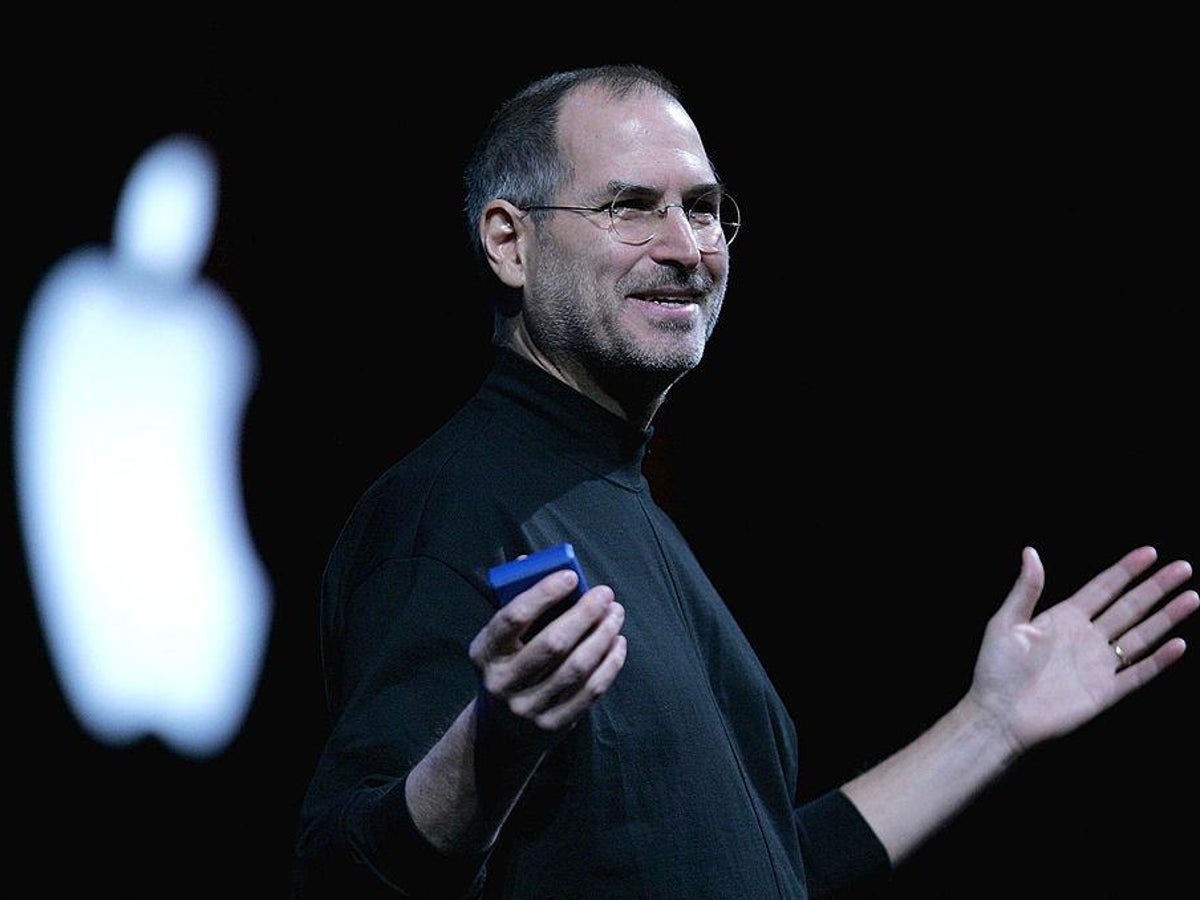
Jobs reached the zenith of his executive career on January 9, 2007, when he stepped onto the stage at Macworld in San Francisco to announce a revolutionary product that combined three devices into one: “a widescreen iPod with touch controls, a revolutionary mobile phone, and a breakthrough internet communications device.” The iPhone shattered standard smartphone paradigms by discarding physical keyboards in favor of a multi-touch capacitive screen. In 2008, Apple launched the App Store, creating a thriving global ecosystem for software developers and permanently altering human communication, commerce, and media consumption. Jobs followed this milestone in 2010 with the launch of the iPad, establishing the tablet computing category.
Throughout his career, Jobs received numerous honors, including the National Medal of Technology and Innovation from President Ronald Reagan in 1985, induction into the California Hall of Fame in 2007, and a posthumous Presidential Medal of Freedom awarded by President Joe Biden in 2022. He was named Time magazine’s Person of the Year finalist multiple times and recognized by Fortune as the CEO of the Decade in 2009.
Life with Laurene Powell Jobs, the Woodside Estate, and Private Zen Retreats
Steve Jobs’s personal life was marked by intense emotional complexities, deep private relationships, and dramatic personal transformations. In 1970, at age 15, Jobs met Chrisann Brennan at Homestead High School. The two maintained an off-and-on romantic relationship throughout his early adulthood. In 1977, while Jobs was establishing Apple, Brennan became pregnant. Jobs initially denied paternity, claiming he was sterile, and refused to provide financial support or acknowledge the child. In May 1978, Brennan gave birth to a daughter, Lisa Brennan. After a court-ordered DNA paternity test confirmed he was the father, Jobs was legally mandated to pay $385 a month in child support, which he paid despite Apple’s recent public valuation making him immensely wealthy. Over time, Jobs reconciled with Lisa, apologizing for his early behavior, funding her education at Harvard University, and welcoming her into his home, though their relationship remained complex throughout his life.
In the 1980s, Jobs was one of Silicon Valley’s most eligible bachelors and engaged in high-profile romantic relationships. He dated folk musician Joan Baez for several years, a relationship driven in part by his deep adoration for Bob Dylan, whom Baez had famously dated decades prior. He also maintained an intense, tumultuous multi-year relationship with computer engineer and heiress Tina Redse, whom Jobs described as one of the deepest loves of his life. However, Redse rejected his marriage proposal, citing his emotional volatility and uncompromising intensity.
In October 1989, while giving a guest lecture at the Stanford Graduate School of Business, Jobs met Laurene Powell, an MBA student sitting in the front row. Captivated by her intellect and poise, Jobs pursued her immediately. The couple was married on March 18, 1991, in a private Zen Buddhist ceremony at the Ahwahnee Hotel in Yosemite National Park, presided over by Jobs’s spiritual guru, Kobun Chino Otogawa. Jobs and Laurene enjoyed a devoted marriage that lasted until his death. They raised three children together: Reed (born 1991), Erin (born 1995), and Eve (born 1998). The family resided in a modest, unpretentious brick home in Palo Alto, California, intentionally avoiding high-security gates or ostentatious displays of wealth to afford their children a relatively normal upbringing.
Outside of executive leadership, Jobs led an intensely private life grounded in strict personal habits. A lifelong vegetarian and frequent fruitarian, he engaged in long, fasting cleanses and held precise dietary preferences. His wardrobe became iconic: a custom black silk-and-cotton mock turtleneck designed by Issey Miyake, paired with Levi’s 501 jeans and New Balance 991 sneakers. He was an avid fan of acoustic music, industrial design, architecture, and landscaping, spending years personally detailing every aspect of his family residence and his custom-designed 256-foot superyacht, Venus, which was completed shortly after his passing.

Deposition Room Battles: Corporate Governance Crises and Federal Regulatory Scrutiny
The Lisa Computer Era: Paternity Disputes and Early Boardroom Alienation
The most enduring personal controversy of Steve Jobs’s early career was his public denial of his firstborn daughter, Lisa Brennan-Jobs. In 1979, while swearing legal depositions regarding paternity, Jobs claimed under oath that he was infertile and physically incapable of fathering children. Concurrently, Apple was developing a high-end personal computer named the “Apple Lisa.” When press outlets questioned whether the machine was named after his newborn child, Jobs repeatedly insisted that “Lisa” was simply an acronym for “Local Integrated Software Architecture.”
The public backlash intensified as Apple went public, turning Jobs into a multi-millionaire while Brennan and Lisa survived on welfare benefits and state assistance. Media outlets criticized Jobs’s personal ethics, casting a shadow over his public image as a counterculture visionary. Years later, Jobs admitted to his biographer Walter Isaacson and publicly confessed that he had acted callously out of fear and emotional unreadiness. He acknowledged that the computer was indeed named after his daughter, stating simply, “Obviously, it was named for my daughter.”
Federal Audits: The SEC Investigation into Apple Stock Options Grants
In 2006, Apple became embroiled in a major corporate scandal regarding the backdating of executive stock option grants. An internal investigation revealed that between 1997 and 2002, thousands of stock options had been awarded with backdated grant dates to maximize financial payouts for executives, including two large grants awarded to Jobs himself—7.5 million shares in 2001. Under federal securities laws, backdating without proper accounting disclosure constitutes corporate fraud and tax evasion.
The controversy led to high-stakes investigations by the U.S. Securities and Exchange Commission (SEC) and the Department of Justice, threatening Jobs’s position as CEO. Apple appointed an independent special committee to audit the company’s financial records. The investigation ultimately cleared Jobs of personal misconduct, concluding that while he was aware of and favored the selection of favorable grant dates, he did not personally benefit financially from the backdated options or understand the technical accounting implications. Apple was forced to restate years of financial earnings, resulting in an $84 million adjustment, while two former top executives faced regulatory sanctions.
Antitrust Class Actions: Silicon Valley Anti-Poaching Suits and Foxconn Supply Chains
In his final years, Jobs was involved in a landmark civil antitrust lawsuit brought by the U.S. Department of Justice against major Silicon Valley firms, including Apple, Google, Adobe, and Intel. The lawsuit alleged that Jobs and executives from rival tech firms entered into illegal “no-poach” agreements between 2005 and 2009, secretly agreeing not to cold-call or recruit each other’s software engineers to suppress industry wages. Internal emails released during litigation revealed Jobs taking an aggressive stance, demanding rival executives cease hiring Apple employees under threat of legal and corporate retaliation. The affected companies ultimately settled the class-action lawsuit in 2015 for $415 million.
Additionally, as Apple’s global manufacturing scaled exponentially following the release of the iPhone, the company faced intense international media scrutiny regarding labor practices at its primary manufacturing partner, Foxconn, in Shenzhen, China. Reports of long working hours, harsh factory floor conditions, and a series of tragic employee suicides in 2010 brought intense public pressure on Jobs’s supply chain management. In response, Jobs launched sweeping corporate transparency initiatives, establishing third-party labor audits, enforcing international work-hour limits, and creating the Apple Supplier Code of Conduct.

The 'Think Different' Philosophy: Steven Paul Jobs and Corporate Product Architecture
Steve Jobs’s design aesthetic profoundly shaped global modern industrial taste. Believing that visual simplicity was the ultimate form of sophistication, he championed a minimalist philosophy that integrated hardware and software into seamless, closed ecosystems. He rejected market research, famously stating, “It’s really hard to design products by focus groups. A lot of times, people don’t know what they want until you show it to them.” This conviction birthed an era of consumer electronics characterized by glass, aluminum, unibody construction, and intuitive interfaces.
His theatrical product keynotes became legendary corporate performances. Clad in his uniform signature style, Jobs mastered the art of stagecraft, utilizing minimal slides, dramatic pauses, and surprising audience reveals—often introduced with his iconic catchphrase, “One more thing…” These events set a new standard for corporate product launches across the global technology landscape, transforming corporate press releases into massive global entertainment events watched live by millions.
Though Steve Jobs passed away before the modern era of personal social media dominance—never holding an official personal Twitter/X, Instagram, or public social media account—his digital footprint is omnipresent. The hardware devices, operating systems, mobile applications, and digital delivery systems he pioneered serve as the physical and operational foundation for contemporary social media networks, modern mobile commerce, and global cloud computing.
The iPad, Apple Campus 2, and the Institutional Legacy of Steven Paul Jobs
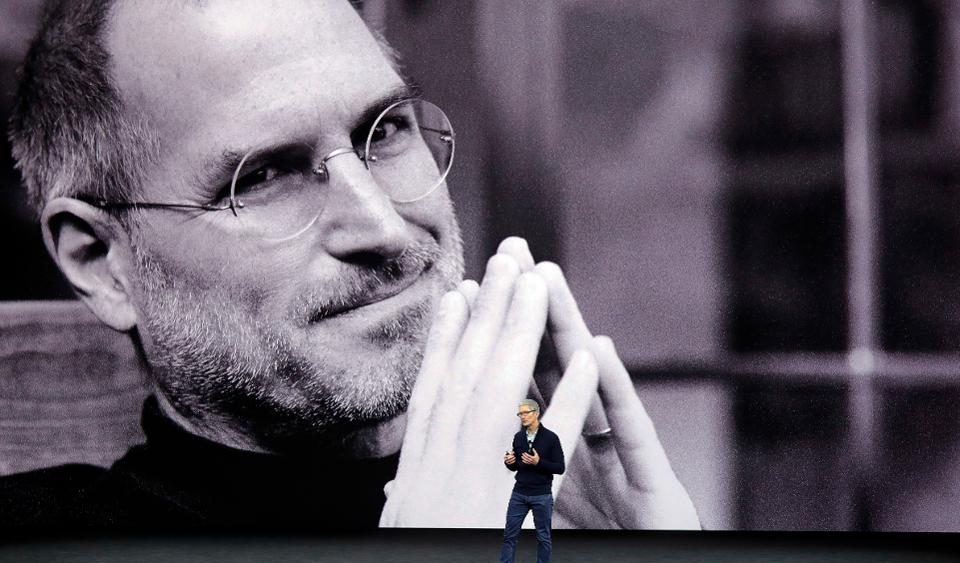
Steve Jobs’s personal life journey reached its heroic yet tragic conclusion on October 5, 2011, when he passed away at his home in Palo Alto, California, at the age of 56. His death was caused by respiratory arrest related to a neuroendocrine tumor—a rare form of pancreatic cancer—with which he had been diagnosed in October 2003. After initially attempting to treat his condition through alternative medicine, specialized diets, and holistic therapies for nine months, Jobs underwent a pancreaticoduodenectomy (Whipple procedure) in 2004, followed by a liver transplant in 2009, before resigning as CEO of Apple in August 2011.
Despite his physical passing, Jobs’s future horizons live on through the enduring institutional legacy of Apple Inc., which became the first publicly traded company in history to achieve market capitalizations of $1 trillion, $2 trillion, and $3 trillion. The design principles, corporate culture, and strategic framework he established continue to drive innovation at Apple Park—the ring-shaped corporate campus in Cupertino whose architectural concept was Jobs’s final major project presented to the city council in June 2011.
Additionally, his family’s philanthropic impact continues through Laurene Powell Jobs and the Emerson Collective, an organization focused on education, environmental reform, media, and social justice. Steve Jobs’s life narrative remains preserved through Walter Isaacson’s authorized biography, landmark documentary films, feature motion pictures, and educational institutions worldwide, cementing his permanent status as one of history’s greatest innovators.
Steven Paul Jobs FAQs: Key Questions Answered
How old was Steve Jobs when he passed away?
Steve Jobs passed away on October 5, 2011, at the age of 56, following a courageous multi-year battle with a neuroendocrine pancreatic tumor.
Who was Steve Jobs married to, and did he have children?
Steve Jobs was married to Laurene Powell Jobs from 1991 until his death in 2011. Together they had three children: Reed, Erin, and Eve. Jobs also had a daughter, Lisa Brennan-Jobs, from an earlier relationship with Chrisann Brennan.
What is Steve Jobs’s most famous invention or product launch?
While Jobs co-created iconic products like the Apple II, Macintosh, and iPod, his most revolutionary contribution was the iPhone, launched in January 2007, which fundamentally reshaped mobile telecommunications, mobile internet usage, and global consumer technology.
What was Steve Jobs’s net worth at the time of his death?
At the time of his death in October 2011, Forbes estimated Steve Jobs’s net worth at approximately $10.2 billion. The majority of his fortune stemmed from his majority ownership stake in The Walt Disney Company following Disney’s acquisition of Pixar.


