: “
Michael Jeffrey Jordan at Emsley A. Laney High School: Varsity Cut to McDonald's All-American

Michael Jeffrey Jordan was born on February 17, 1963, at Cumberland Hospital in Brooklyn, New York. His mother, Deloris Jordan (née Peoples), worked in banking, while his father, James R. Jordan Sr., was an equipment supervisor at General Electric. Seeking a safer and more nurturing environment for their family, the Jordans relocated to Wilmington, North Carolina, when Michael was still a toddler. Growing up in a disciplined, middle-class household alongside four siblings—Larry, James Jr., Deloris, and Roslyn—young Michael inherited a fierce work ethic and a relentlessly competitive spirit that would come to define his legendary persona.
During his early childhood, sports were a central pillar of the Jordan home. Interestingly, Michael’s initial athletic passion was baseball rather than basketball. He pitched and played outfield in Little League, earning local honors and showcasing natural hand-eye coordination. However, as he matured, the back-yard basketball battles against his older brother Larry forged his obsession with the court. Larry, though shorter, routinely beat Michael in one-on-one matchups, fueling Michael’s burning desire to improve and surpass his sibling’s athletic prowess.
Michael attended Emsley A. Laney High School in Wilmington, where his athletic narrative hit a famous early roadblock. As a 5-foot-11 sophomore in the autumn of 1978, Jordan attempted to join the varsity basketball team. The coaching staff deemed him too short and selected his 6-foot-7 classmate, Leroy Smith, instead, reassigning Michael to the junior varsity roster. Rather than deterring him, the rejection sparked a psychological firestorm. Jordan used the setback as daily motivation, practicing relentlessly and scoring over 40 points per game for the JV squad. A sudden growth spurt over the summer of 1979 pushed him to 6-foot-3, and when he finally joined varsity as a junior, he dominated. By his senior year, averaging a triple-double, he was selected as a McDonald’s All-American and caught the eyes of major collegiate scouts nationwide.
Michael Jeffrey Jordan's 1982 NCAA Championship Clutch Shot: Sinking the Game-Winner Against Georgetown
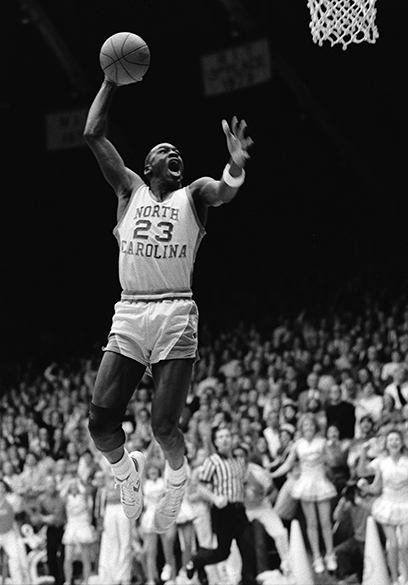
In 1981, Michael Jordan accepted a basketball scholarship to the University of North Carolina at Chapel Hill, majoring in cultural geography and playing under legendary head coach Dean Smith. Coach Smith’s rigorous system emphasized team fundamentals, defensive discipline, and tactical execution, refining Jordan’s raw athletic talent into a sophisticated basketball mind. Jordan quickly earned ACC Freshman of the Year honors, but his true national breakthrough occurred on March 29, 1982, during the NCAA National Championship game against Georgetown University.
With just 15 seconds remaining on the clock and North Carolina trailing by one point, Jordan received a cross-court pass and calmly sunk a baseline jump shot to secure a 63-62 victory. The game-winning shot catapulted the 19-year-old into the national sports lexicon. Jordan would later credit that exact moment as the turning point of his career, transforming his internal self-belief from a promising prospect to a proven big-stage performer. Across his three collegiate seasons, Jordan averaged 17.7 points per game, earned Consensus First-Team All-American honors twice, and won the Naismith and Wooden College Player of the Year awards in 1984.
Following his junior season, Jordan declared for the 1984 NBA Draft. Selected third overall by the Chicago Bulls—behind Hakeem Olajuwon and Sam Bowie—Jordan stepped into a struggling franchise that had drawn low attendance figures for years. That same summer, Jordan led the 1984 United States Men’s Olympic Basketball Team to a gold medal in Los Angeles under coach Bobby Knight, providing a vibrant preview of the explosive athleticism, gravity-defying leaps, and defensive tenacity he was about to unleash upon the National Basketball Association.
Michael Jeffrey Jordan's Chicago Bulls Dynasty: Six NBA Finals MVP Trophies and Championship Hauls

Michael Jeffrey Jordan and the 1992 USA Dream Team: Barcelona Olympic Gold Medal Triumph
Michael Jordan’s NBA debut came on October 26, 1984, against the Washington Bullets, scoring 16 points and immediately thrilling the Chicago crowd. In his rookie campaign, Jordan took the league by storm, averaging 28.2 points, 6.5 rebounds, and 5.9 assists per game while shooting 51.5 percent from the field. He restored credibility to the Bulls franchise, earned an All-Star starter spot in his first year, appeared on the cover of Sports Illustrated with the caption ‘A Star is Born,’ and rightfully captured the 1985 NBA Rookie of the Year award.
Outside the arena, 1984 marked the birth of a revolutionary marketing engine. Jordan signed a ground-breaking endorsement contract with Nike worth $500,000 annually plus royalties—an unprecedented gamble for a rookie athlete. Nike launched the original Air Jordan sneakers in early 1985. The NBA initially banned the black-and-red footwear for violating uniform guidelines, issuing a $5,000 fine per game. Nike paid every fine, leveraging the ban into a masterclass marketing campaign. The Air Jordan line generated over $100 million in sales in its first year alone, forever shifting the economic paradigm of individual athlete endorsements.
Despite a major setback in his second season—a broken navicular bone in his left foot on October 29, 1985, which sidelined him for 64 games—Jordan returned for the 1986 playoffs. On April 20, 1986, against the eventual champion Boston Celtics at the Boston Garden, Jordan delivered a historic 63-point performance. Celtics legend Larry Bird famously remarked after the game that it was ‘God disguised as Michael Jordan.’ The 1986-87 season witnessed Jordan scoring 3,041 points (averaging 37.1 points per game), becoming only the second player after Wilt Chamberlain to surpass 3,000 points in a single season, and winning the first of ten consecutive scoring titles.
Michael Jeffrey Jordan's Global Basketball Footprint: NBA Paris Games and Worldwide Dominance
Despite individual individual accolades—including his first regular-season MVP and Defensive Player of the Year award in 1988—Jordan faced intense team-level postseason heartbreak. Between 1988 and 1990, the Chicago Bulls were repeatedly knocked out of the playoffs by the physical ‘Bad Boys’ Detroit Pistons, who employed physical tactical defensive schemes known as the ‘Jordan Rules.’ Under the guidance of head coach Phil Jackson and assistant Tex Winter, who implemented the triangle offense, Jordan learned to elevate his teammates, most notably Scottie Pippen and Horace Grant.
The dawn of the 1990s heralded an unparalleled era of dominance. In 1991, Jordan led the Bulls to a 61-21 regular season record, swept the Pistons in the Eastern Conference Finals, and defeated Magic Johnson‘s Los Angeles Lakers 4-1 in the NBA Finals to secure the franchise’s first-ever NBA Championship. Jordan wept tears of joy holding the Larry O’Brien Trophy, averaging 31.2 points, 11.4 assists, and 6.6 rebounds to earn his first Finals MVP. The Bulls repeated as champions in 1992 by defeating the Portland Trail Blazers, during which Jordan famously executed ‘The Shrug’ after hitting six three-pointers in a single half in Game 1.
In the summer of 1992, Jordan anchored the iconic USA ‘Dream Team’ at the Barcelona Olympics alongside Magic Johnson, Larry Bird, and Charles Barkley. Captivating global audiences, the Dream Team dominated their opponents by an average of 43.8 points, single-handedly globalizing the game of basketball. Returning for the 1992-93 NBA season, Jordan guided Chicago to a historic ‘three-peat’ championship victory over Charles Barkley’s Phoenix Suns, averaging a Finals record 41.0 points per game across the six-game series.
Michael Jeffrey Jordan's Naismith Hall of Fame Legacy: Ten Scoring Titles and All-Time Records
Following a shock retirement in October 1993 and a 14-month minor league baseball stint with the Birmingham Barons (an affiliate of the Chicago White Sox), Jordan sent shockwaves through the sports landscape on March 18, 1995, with a simple two-word press release: ‘I’m back.’ Returning in jersey No. 45, he scored 55 points against the New York Knicks at Madison Square Garden just five games into his comeback. After a playoff exit to the Orlando Magic in 1995, Jordan underwent intense summer conditioning, reclaiming his iconic No. 23 jersey and transforming his physical game to emphasize a lethal, unguardable fadeaway jumper over raw athleticism.
The 1995-96 Bulls, bolstered by the addition of rebounder Dennis Rodman, stormed to an unprecedented 72-10 regular-season record. Jordan swept the regular-season MVP, All-Star Game MVP, and Finals MVP awards as Chicago defeated the Seattle SuperSonics on Father’s Day 1996—a emotional victory coming three years after his father’s passing. Jordan replicated championship runs in 1997 against the Utah Jazz—highlighted by the legendary ‘Flu Game’ in Game 5 where he scored 38 points while severely ill—and again in 1998.
On June 14, 1998, in Game 6 of the NBA Finals against Utah, Jordan executed what is widely considered the most iconic closing sequence in basketball history. Stealing the ball from Karl Malone with 20 seconds remaining, Jordan drove down court, crossed over defender Bryon Russell, and drained a 17-foot jumper with 5.2 seconds left to seal his sixth NBA Championship and sixth Finals MVP. He retired for a second time in January 1999.
Jordan made a final comeback from 2001 to 2003 with the Washington Wizards, donating his entire player salary to 9/11 relief efforts. Though in his late 30s and suffering knee injuries, he averaged over 20 points per game, scored his 30,000th career point, and became the oldest player in NBA history to score 50+ points in a single game before officially retiring for good on April 16, 2003. He was inducted into the Naismith Memorial Basketball Hall of Fame in 2009 and the FIBA Hall of Fame in 2015.
Michael Jeffrey Jordan Off the Court: Juanita Vanoy Marriage, Yvette Prieto Family, and Private Enterprises
Michael Jordan’s personal life has been defined by high-profile relationships, deep devotion to his family, and intense privacy protection. In September 1989, at the height of his early NBA fame, Jordan married Juanita Vanoy at A Little White Wedding Chapel in Las Vegas, Nevada. The couple had first met at a Chicago restaurant in 1984. Together, they welcomed three children: Jeffrey Michael (born 1988), Marcus James (born 1990), and Jasmine Mickael (born 1992). During their 17-year marriage, the family resided in a sprawling 56,000-square-foot luxury estate in Highland Park, Illinois.
In January 2002, Juanita filed for divorce, citing irreconcilable differences. Although the couple initially reconciled, they finalized their amicable dissolution in December 2006. The court settlement granted Juanita an estimated $168 million, making it one of the largest celebrity divorce settlements in public history at the time. Despite the separation, both parents remained active co-parents to their three children, who all pursued careers connected to sports, business, and fashion. Marcus Jordan notably launched the boutique sneaker retailer Trophy Room, while Jasmine served as a field executive for Jordan Brand.
In 2008, Jordan met Cuban-American model Yvette Prieto at a Miami nightclub. After five years of dating, the couple married in an extravagant ceremony on April 27, 2013, at Episcopal Church of Bethesda-by-the-Sea in Palm Beach, Florida, followed by a reception attended by over 500 guests, including Tiger Woods, Spike Lee, and Patrick Ewing. In February 2014, Yvette gave birth to identical twin daughters, Victoria and Ysabel Jordan. Away from public view, Jordan is an avid golfer, hosting charity tournaments, and a passionate enthusiast of luxury yachts, fine cigars, and high-performance motorsports.
Michael Jeffrey Jordan's High-Stakes Hurdles: Media Scrutiny, Sabbaticals, and Championship Comebacks
Michael Jeffrey Jordan and the 1993 Atlantic City Casino Trip: Navigating NBA Inquiries and Gambling Scrutiny
While Michael Jordan’s athletic brilliance built an immortal public persona, his obsession with competition frequently spilled into high-stakes gambling, leading to major public controversies and federal court proceedings in the early 1990s. The initial rupture in Jordan’s squeaky-clean endorsement image occurred in 1992, when federal authorities seized a $57,000 cashier’s check signed by Jordan from the bank account of James ‘Slim’ Bouler, a convicted drug dealer and illegal poker operator. Jordan initially claimed to reporters that the check was a personal loan. However, testifying under oath in federal court in October 1992, Jordan recanted his previous statement, admitting that the money was an unpaid debt from high-stakes golf and card games.
The scandal intensified in 1993 with the publication of the book Michael & Me: Our Gambling Addiction… My Cry for Help!, written by San Diego businessman Richard Esquinas. Esquinas claimed that Jordan owed him over $1.25 million in golf betting losses incurred over ten days in San Diego, which was later negotiated down to $300,000. Public backlash mounted further during the 1993 Eastern Conference Finals against the New York Knicks, when Jordan was spotted gambling at a casino in Atlantic City, New Jersey, late into the night before Game 2. Media outlets questioned his commitment, focus, and potential vulnerability to illicit bookmakers. The NBA launched an internal investigation into Jordan’s gambling activities to determine if league rules were breached or if his habits threatened integrity of games. The investigation concluded in late 1993, clearing Jordan of any illegal wrongdoing, though the league formally reprimanded him for exercise of poor judgment.
Michael Jeffrey Jordan's Switch to Birmingham Barons Baseball Following the Tragic Loss of James Jordan Sr.
On July 23, 1993, tragedy struck the Jordan family when Michael’s father, James Jordan Sr., was brutally murdered at a highway rest stop in Robeson County, North Carolina, by two local teenagers who stole his Lexus and personal possessions. The sudden loss devastated Michael, who viewed his father as his ultimate confidant and best friend. Media sensationalism rapidly reached a fever pitch, with several tabloid outlets insidiously speculating without evidence whether James Sr.’s murder was connected to Michael’s gambling debts. Law enforcement investigations quickly debunked these conspiracy theories, confirming the crime was a senseless random robbery.
Overwhelmed by intense grief and exhausted by constant media scrutiny, Michael announced his shock retirement from professional basketball on October 6, 1993, at age 30, declaring he had lost his passion for the game. conspiracy theorists wrongly claimed his departure was a secret league suspension—a narrative vehemently denied by both Jordan and NBA Commissioner David Stern. Jordan pivoted to professional baseball, signing a minor league contract with the Chicago White Sox in memory of his father, who had always dreamed of Michael playing Major League Baseball. His grueling stint with the Birmingham Barons demonstrated immense humbleness and discipline, earning respect across sports. When he returned to the NBA in 1995, Jordan transformed his grief into unprecedented competitive mastery, regaining complete control over his narrative and elevating his international stature to unmatched height.
Michael Jeffrey Jordan's Air Jordan Brand Empire: Nike Sneaker Line, Tim Grover Training, and Billionaire Stature
Michael Jordan’s cultural footprint extends far beyond the hardwood, completely restructuring global sports marketing, urban fashion, and pop culture economics. In the late 1980s and 1990s, Jordan popularized longer, baggier basketball shorts, shifting away from the traditional tight uniforms of previous decades. His signature shaved head, gold hoop earring, and habit of wagging his tongue during drives to the rim became globally recognized fashion statements emulated by millions of young fans around the world.
The Jordan Brand, a subsidiary of Nike launched in 1997, remains the premier sneaker standard worldwide. Generating billions of dollars in annual revenue, Retro Air Jordans remain high-value collector items, bridging athletic performance with streetwear fashion. Furthermore, Jordan starred alongside Bugs Bunny in the iconic 1996 live-action/animated blockbuster Space Jam, which grossed over $230 million worldwide and solidified his status as a Hollywood box-office draw.
Unlike contemporary superstar athletes, Michael Jordan maintains no personal public social media accounts on platforms like X (Twitter), Instagram, or Facebook. He deliberately avoids sharing personal daily updates or online debates, relying instead on official brand channels like Jumpman23 and corporate communications to maintain an aura of mystique. His career and final championship season were immortalized in the 2020 ESPN/Netflix documentary mini-series The Last Dance, which drew tens of millions of viewers globally, introducing his ferocious competitive mentality to a new digital-native generation.
Michael Jeffrey Jordan's Executive Next Phase: Charlotte Hornets Ownership, 23XI Racing, and Golf Legacy
In his post-playing years, Michael Jordan transitioned into an influential sports executive and business tycoon. In 2010, he purchased majority ownership of the Charlotte Bobcats (now Hornets) for $275 million, becoming the first former player to serve as a majority owner in NBA history. In August 2023, Jordan completed the sale of his majority stake in the Hornets for an astounding $3 billion, retaining a minority ownership share while realizing one of the most profitable franchise returns in professional sports history.
Jordan continues to expand his business ventures into elite motorsports and luxury entertainment. In late 2020, he co-founded the NASCAR Cup Series team 23XI Racing alongside driver Denny Hamlin, fielding top drivers such as Bubba Wallace and Tyler Reddick. Additionally, Jordan is a co-owner of Cincoro Tequila, an ultra-premium spirits brand launched alongside fellow sports owners, and holds equity investments in sports betting giant DraftKings and various tech startups. Through philanthropic pledges, Jordan has donated tens of millions of dollars to healthcare clinics in North Carolina, social justice initiatives, and educational scholarships, solidifying his enduring legacy as a generational sports icon and visionary entrepreneur.
Michael Jeffrey Jordan FAQs: Key Questions Answered
How old is Michael Jordan?
Michael Jordan was born on February 17, 1963, making him 63 years old as of 2026.
Who is Michael Jordan dating or married to?
Michael Jordan is married to Cuban-American model Yvette Prieto. The couple tied the knot on April 27, 2013, in Palm Beach, Florida, and have twin daughters together. Jordan was previously married to Juanita Vanoy from 1989 to 2006.
What is Michael Jordan’s most famous achievement?
Michael Jordan is best known for winning six NBA Championships with the Chicago Bulls across two separate ‘three-peats’ (1991–1993, 1996–1998), earning Finals MVP in all six victories. He also won five regular-season NBA MVP awards and two Olympic Gold Medals (1984, 1992).
Does Michael Jordan have personal social media accounts?
No, Michael Jordan does not operate any personal public social media accounts on Instagram, X (Twitter), or Facebook. Authentic content related to his legacy and business endeavors is officially published through the Jordan Brand (@Jumpman23) and associated corporate channels.