Steventon Rectory Beginnings and the Birth of Jane Austen's Juvenilia

Jane Austen was born on December 16, 1775, in the tranquil parish of Steventon, Hampshire, England. She entered a close-knit, highly intellectual household as the seventh child and second daughter of the Reverend George Austen and Cassandra Leigh Austen. Her father, the rector of the local Anglican parish, supplemented the family income by tutoring private pupils, turning the Steventon rectory into a bustling center of learning, debate, and literary exploration. It was within this vibrant, book-filled environment that Jane developed an early and insatiable passion for language, storytelling, and social observation.
Her family background provided an exceptional foundation for her artistic development. Unlike many young women of the Georgian era whose educations were strictly confined to ornamental accomplishments, Jane enjoyed unrestricted access to her father’s extensive library. Alongside her beloved elder sister, Cassandra—who remained her closest confidante, advisor, and companion throughout her entire life—Jane was briefly sent to formal institutions, including the Abbey School in Reading. However, a near-fatal bout of typhus in 1783 and subsequent financial limitations brought her formal schooling to an end by 1786. From that point forward, her education was predominantly home-based, nurtured by her father, her brothers, and an endless stream of classic literature, theatrical performances, and lively debates in the family drawing room.
Austen’s creative spark ignited remarkably early. Between 1787 and 1793, while still an adolescent, she authored an extensive body of work collectively known as the Juvenilia. These writings consisted of hilarious parodies of popular 18th-century sentimental novels, anarchic comedies, sharp political satire, and short plays performed for family entertainment. Works such as Love and Freindship [sic] and The History of England revealed a strikingly mature literary voice—one characterized by piercing wit, a refusal to accept societal hypocrisy, and an instinct for stripping away romantic sentimentality to expose human absurdities.
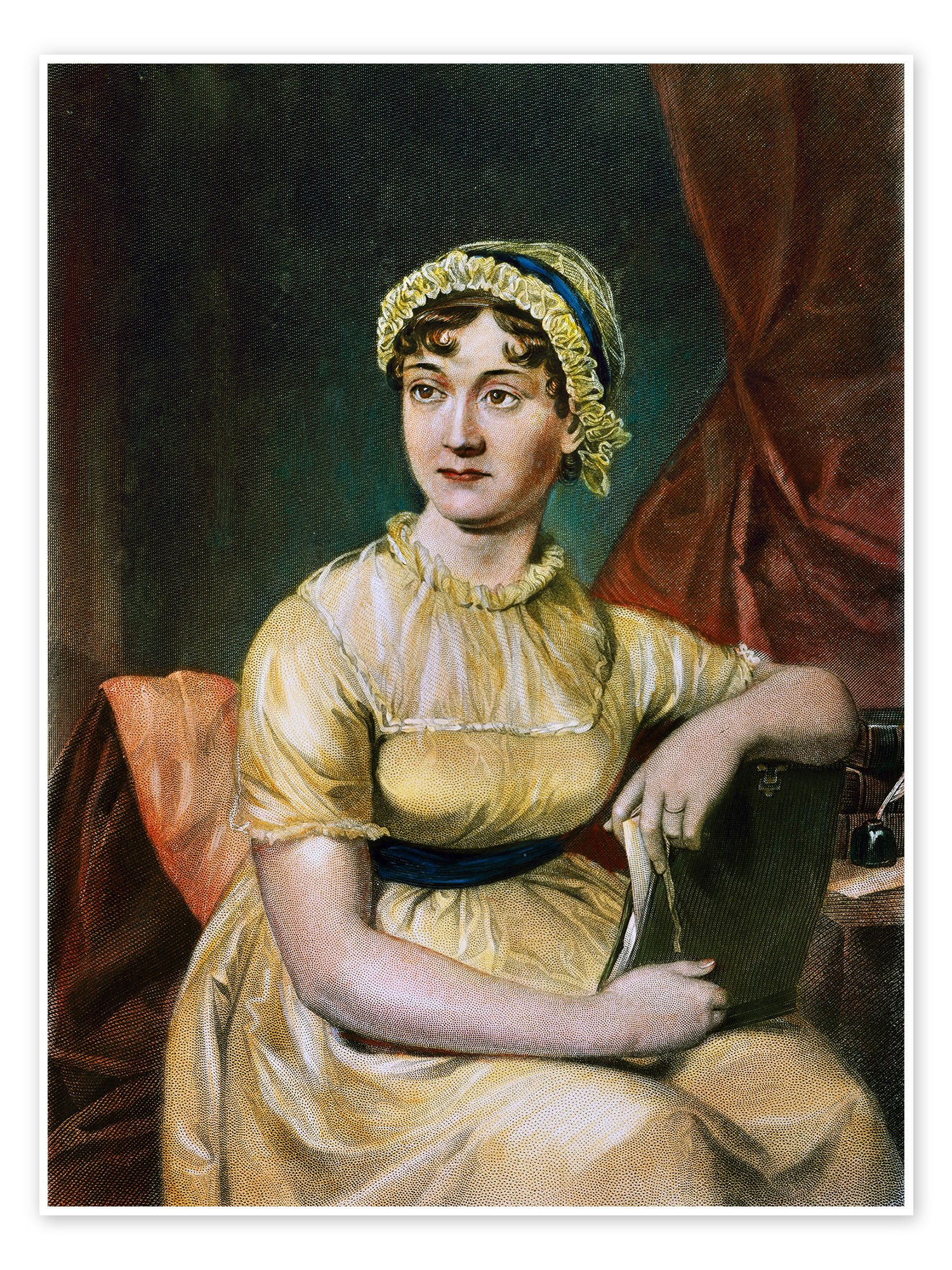
Jane Austen Penning the First Drafts of Sense and Sensibility and Pride and Prejudice
By the mid-1790s, Austen turned her artistic ambitions toward serious, full-length prose fiction. In her early twenties, working at a small mahogany writing desk in Steventon, she embarked on a flurry of intense composition that laid the groundwork for her greatest masterpieces. Between 1795 and 1799, she penned the initial drafts of three major works: Elinor and Marianne (which would later evolve into Sense and Sensibility), First Impressions (the preliminary version of Pride and Prejudice), and Susan (later published as Northanger Abbey).
Recognizing his daughter’s extraordinary talent, Reverend George Austen made a bold attempt to launch her literary career in November 1797. He wrote directly to the prominent London publisher Thomas Cadell, offering the manuscript of First Impressions for consideration. However, in a stingingly dismissive response that would become legendary in publishing history, Cadell rejected the manuscript by return post without even requesting to examine the text. Undeterred by this initial rejection, Jane continued her work, refining her compositions and experimenting with narrative voice, particularly pioneering the technique of free indirect discourse—a revolutionary stylistic breakthrough that allowed readers to experience a character’s internal thoughts while maintaining a third-person narrative framework.
The path to publication proved long and arduous, delayed by major personal disruptions including the family’s move to Bath in 1801 and her father’s death in 1805. The breakthrough finally arrived in late 1810 when London publisher Thomas Egerton agreed to publish Sense and Sensibility on commission. Under this arrangement, Austen assumed the financial risk of printing, advertising, and production, while Egerton distributed the work. When the novel appeared in late October 1811, published anonymously under the simple attribution “By a Lady,” it created an immediate stir among fashion-conscious Regency readers. The entire print run of approximately 1,000 copies sold out within two years, yielding Austen a net profit of £140 and officially establishing her as a professional force in British letters.
Jane Austen's Chawton Years and Anonymous Landmark Novels

Jane Austen Publishing Mansfield Park and Emma under Thomas Egerton and John Murray
Following the commercial success of her debut, Austen moved quickly to capitalize on her momentum. In January 1813, Egerton published her second novel, Pride and Prejudice, for which she had sold the copyright outright for £110. Described by Austen in a letter to her sister as her “own darling child,” the story of Elizabeth Bennet and Fitzwilliam Darcy achieved instant acclaim. Readers and contemporary critics praised its sparkling dialogue, exquisite narrative pacing, and the brilliantly orchestrated battle of wits between its central protagonists. The novel sold through its initial printing rapidly, necessitating a second edition within months and catapulting Austen’s anonymous literary identity into an open secret among high-society circles.
Buoyed by her rising public profile, Austen entered an exceptionally productive creative period at Chawton Cottage in Hampshire, where she lived with her mother, sister, and friend Martha Lloyd. In May 1814, she published Mansfield Park through Egerton. A darker, more complex exploration of morality, social climbing, and institutional integrity, Mansfield Park became the biggest commercial success of her lifetime. The entire edition sold out in under six months, earning Austen more income than any of her individual prior releases, despite receiving mixed responses from readers who preferred the effervescent humor of her earlier work.

Jane Austen's International Translation History and French Editions
By 1815, Austen stood at the absolute zenith of her career as an author. Seeking greater control over her publishing affairs and higher financial returns, she switched publishers to John Murray, one of London’s most esteemed publishing houses. Murray published her fourth novel, Emma, in December 1815 (dated 1816). Centered on the flawed, self-assured, yet endearing heiress Emma Woodhouse, the novel represented a dramatic leap in narrative complexity and psychological realism. Austen famously remarked before writing it, “I am going to take a heroine whom no one but myself will much like,” yet she crafted a universally celebrated masterpiece of irony and domestic intrigue.
The cultural footprint of Emma extended into the highest echelons of British society. The Prince Regent (later King George IV), an avid admirer of Austen’s fiction, requested through his librarian, Reverend James Stanier Clarke, that the novel be dedicated to him. Although Austen harbored personal distaste for the Prince’s notoriously extravagant lifestyle and public marital scandals, she felt compelled to comply, featuring a formal royal dedication in the opening pages of Emma. Furthermore, legendary historical novelist Sir Walter Scott published an influential, glowing review of Emma in the Quarterly Review, praising Austen’s unparalleled ability to capture the authentic, everyday realities of common life with exquisite precision.

Jane Austen's Pioneering Mastery of Free Indirect Discourse
Austen’s final creative phase produced her most mature and poignant works. In 1815 and 1816, despite her declining health, she composed Persuasion, a deeply emotional story exploring second chances, regret, and enduring love through the figure of Anne Elliot. Simultaneously, she bought back the long-dormant manuscript of Susan, revising it into Northanger Abbey. Together, these two novels were published posthumously by John Murray in December 1817 (dated 1818), accompanied by a famous biographical notice written by her brother Henry Austen, which officially revealed Jane Austen’s name to the reading public for the first time.
While formal award structures like modern literary prizes did not exist in Regency England, Austen’s industry stature grew exponentially following her death. Over the 19th and 20th centuries, scholars, critics, and readers elevated her to the upper echelon of world literature alongside William Shakespeare and Charles Dickens. Her acute social critique, mastery of irony, and structural perfection established the modern novel of manners, profoundly influencing generations of writers ranging from George Eliot and Henry James to Virginia Woolf and contemporary authors worldwide.
Jane Austen's Steventon and Chawton Households and Bond with Cassandra Austen
Despite the vibrant social gatherings and intricate romantic plots that defined her fiction, Jane Austen’s personal life was remarkably quiet, grounded in deep family loyalty and rural domesticity. She was profoundly devoted to her elder sister, Cassandra. The two sisters were virtually inseparable throughout their lives, sharing a bedroom, maintaining a voluminous correspondence whenever separated, and offering mutual emotional support through personal tragedies and financial hardships.
Austen’s own romantic life contained poignant chapters that mirrored the emotional depth of her heroines. In the winter of 1795–1796, at the age of twenty, Jane experienced a passionate romance with Tom Lefroy, an ambitious young Irish law student visiting relatives in Hampshire. Letters to Cassandra reveal a lively flirtation, shared dances, and mutual intellectual attraction. However, because neither Jane nor Tom possessed significant personal wealth, Lefroy’s family intervened to separate the couple, sending Tom back to London to pursue his legal career. Lefroy eventually became the Lord Chief Justice of Ireland, later admitting to a biographer that he had loved Jane with a “boyish love.”

The most dramatic romantic milestone of Austen’s life occurred in December 1802 while visiting friends at Manydown Park. Harris Bigg-Wither, a wealthy twenty-one-year-old heir to extensive Hampshire estates, proposed marriage to the twenty-six-year-old Jane. Recognizing the immense financial security, comfortable home, and social standing the marriage would provide for herself and her family, Austen initially accepted. However, after a sleepless night of intense reflection, she realized that marrying a man she did not love violated her core personal ethics. The following morning, she courageously withdrew her acceptance, braving social embarrassment and remaining unmarried for the rest of her life—a decision that preserved her absolute independence to write.
Jane Austen Navigating Regency Publishing Hurdles and Copyright Struggles
Jane Austen's Battle to Reclaim the Unpublished Northanger Abbey Manuscript
While modern audiences view Jane Austen as a celebrated literary icon, her professional career was plagued by intense publishing disputes, contractual stagnation, and commercial suppression. The most severe crisis occurred in 1803 regarding her manuscript Susan (later Northanger Abbey). Through her brother Henry and his lawyer, Austen successfully sold the completed manuscript to the London publishing firm Benjamin Crosby & Co. for the modest sum of £10. Crosby advertised the novel as forthcoming in trade catalogues, leading Austen to anticipate her grand literary debut.
However, Crosby & Co. inexplicably shelved the manuscript, refusing to print it year after year while stubbornly retaining the legal copyright. This deliberate suppression devastated Austen during her prime writing years. In April 1809, writing under the pseudonym “Mrs. Ashton Dennis” (ironically initialed MAD), Austen dispatched a furious letter to Benjamin Crosby, demanding to know why her work had been suppressed and threatening to offer the manuscript elsewhere if they failed to publish it immediately. Crosby replied with cold arrogance, stating that they were under no contractual obligation to publish the work and threatening legal prosecution if she attempted to print it with another house. Trapped in a legal deadlock without the £10 required to buy back her copyright, Austen suffered a catastrophic setback that stalled her publishing trajectory for nearly a decade.
Cassandra Austen's Letter Censorship and Henry Austen's Biographic Postscript
Following Austen’s premature death on July 18, 1817, at the age of forty-one—likely caused by Addison’s disease or lymphoma—a second major controversy erupted surrounding her private life and literary legacy. In the decades after her death, surviving family members, led by her sister Cassandra and nephew Edward Austen-Leigh, engaged in systematic editorial censorship. Fearing that Jane’s sharp wit, outspoken commentary on family members, and irreverent social humor would harm her public reputation in the increasingly conservative Victorian era, Cassandra destroyed or heavily redacted thousands of Jane’s personal letters.

This deliberate destruction of primary historical documents sparked fierce debates among literary historians and biographers, who accused the family of sanitizing Austen’s rebellious genius to construct a false narrative of a quiet, saintly “Aunt Jane.” Early Victorian critics further sought to trivialize her achievements, dismissing her realistic focus on domestic life as narrow or politically insignificant. It took decades of rigorous feminist scholarship and archival recovery in the 20th century to dismantle these sanitized myths, exposing the fierce professionalism, artistic resilience, and radical social critique that truly defined Jane Austen’s life and legacy.
Jane Austen's Screen Adaptations and Impact on Modern Literature
Jane Austen’s stylistic innovations transformed the landscape of English fiction. Her signature technique—combining razor-sharp irony, incisive social commentary, and masterfully crafted dialogue—established a new benchmark for realism in the novel. Unlike her contemporaries who relied on gothic sensationalism or melodramatic romance, Austen found profound dramatic tension within ordinary domestic drawing rooms, analyzing how economic necessity, gender inequality, and class dynamics shaped human relationships.
In the modern digital era, despite living two centuries before the advent of the internet, Austen possesses a staggering global media footprint. The global fan culture surrounding her work—collectively known as “Janeites”—spans world-wide societies, international academic conferences, and massive digital communities across platforms like TikTok (“BookTok”), Instagram, and YouTube. Modern screen adaptations, from Colin Firth’s iconic 1995 portrayal of Mr. Darcy to modern cinematic retellings like Clueless (based on Emma) and Fire Island (based on Pride and Prejudice), consistently introduce her stories to new generations of fans worldwide.
Unfinished Works Sanditon and Persuasion Archival Legacy
Over two hundred years after her death, Jane Austen’s literary empire continues to expand exponentially. Scholarly institutions, including the Jane Austen House Museum in Chawton and the Jane Austen Centre in Bath, lead ongoing historical preservation projects, restoring her original residences and digitizing her surviving manuscripts for universal public access.
Furthermore, major film studios and streaming networks consistently greenlight high-budget adaptations and contemporary reimaginings of her bibliography. Upcoming theatrical productions, academic symposia, and global literary festivals dedicated to her works ensure that her sharp social commentary, timeless romantic narratives, and unmatched literary craftsmanship will continue to inspire, entertain, and provoke readers for centuries to come.
Jane Austen FAQs: Key Questions Answered
How old is Jane Austen?
Jane Austen passed away on July 18, 1817, at the age of 41. She was born on December 16, 1775.
Who is Jane Austen dating or married to?
Jane Austen remained unmarried throughout her life. Although she had a notable flirtation with Tom Lefroy in 1795 and briefly accepted a marriage proposal from wealthy heir Harris Bigg-Wither in 1802, she broke off the engagement the following morning to maintain her personal and artistic independence.
What is Jane Austen’s most famous work?
Jane Austen’s most famous novel is Pride and Prejudice, published in 1813. Other iconic masterpieces include Sense and Sensibility, Emma, Mansfield Park, Persuasion, and Northanger Abbey.
What awards has Jane Austen won?
Formal literary awards did not exist during the Regency era. However, Austen has received widespread posthumous honors, including immortalization on the British £10 banknote, induction into major literary halls of fame, and global recognition as one of the greatest novelists in human history.


