: “
1. Early Literary & Creative Awakening, Formative Mentors

Charles-Édouard Jeanneret-Gris, who would later reinvent himself under the iconic pseudonym Le Corbusier, was born on October 6, 1887, in La Chaux-de-Fonds, a small Swiss watchmaking city nestled in the Jura Mountains just miles from the French border. He was raised in a deeply creative and disciplined household; his father, Georges-Édouard Jeanneret-Gris, was an accomplished artisan who enameled watch cases, while his mother, Marie-Charlotte-Amélie Perret, was a piano teacher who instilled in him a lifelong sensitivity to rhythm and structure. Growing up surrounded by the precise mechanical artistry of watch manufacture and the natural majesty of the Alpine landscape, young Charles-Édouard acquired a unique artistic sensibility that balanced rigorous technical craftsmanship with organic form.
At the age of fifteen, he enrolled at the municipal art school in La Chaux-de-Fonds, preparing initially to follow his father into the watchmaking trade. However, his artistic journey took a decisive turn when he came under the mentorship of Charles L’Eplattenier, a visionary teacher who introduced him to the Art Nouveau movement and pushed him to look beyond decorative arts toward fine painting and architecture. L’Eplattenier famously encouraged his reluctant pupil, who initially claimed to have a horror of architects, to pursue building design. In 1905, at just eighteen years old, Jeanneret received his first architectural commission: designing the Villa Fallet for a member of his school’s board.
The success of this early project launched a period of intense travel across Europe from 1907 to 1911—a grand tour that took him through Italy, Vienna, Berlin, Greece, and Istanbul. During these formative journeys, he sketched ancient ruins, studied classical geometry, and apprenticed under legendary structural pioneers, including Auguste Perret in Paris—a master of reinforced concrete—and Peter Behrens in Berlin. These experiences laid the groundwork for a revolutionary architectural philosophy that would fundamentally reshape the modern world.

2. Stepping into the Literary Arena: First Bestsellers & Acclaim
During the upheaval of World War I, Jeanneret returned to Switzerland to teach and conduct theoretical studies that would redefine modern construction. In 1914, working alongside engineer Max Dubois, he patented the structural framework known as the Maison Dom-Ino. This concept abandoned traditional load-bearing walls in favor of an open structure composed of reinforced concrete floor slabs supported by slim vertical columns and connected by a side staircase. The Dom-Ino model was intended to facilitate rapid, mass-produced housing following wartime devastation, giving inhabitants complete freedom to arrange interior walls and exterior facades as they saw fit. It was a conceptual breakthrough that severed architecture from centuries-old masonry constraints.
In 1917, Jeanneret relocated permanently to Paris, a city bustling with avant-garde intellectualism. There, he formed a crucial alliance with the painter Amédée Ozenfant. Together, they authored the manifesto Après le Cubisme (After Cubism) in 1918, launching the art movement known as Purism, which rejected decorative abstraction in favor of pure, geometric, machine-age forms. In 1920, to cement his transformation into an uncompromising modern cultural figure, Jeanneret adopted the moniker Le Corbusier—an altered version of his maternal grandmother’s surname, Lecorbésier, translating loosely to ‘the crow-like one’. Along with Ozenfant and poet Paul Dermée, he founded the revolutionary journal L’Esprit Nouveau, using its pages to publish radical essays on aesthetics, industrialization, and modern living. In 1923, these essays were collected into his epochal book Vers une architecture (Towards an Architecture), featuring his famously provocative aphorism: “A house is a machine for living in.”
3. Defining Canon, Magnum Opus & Stylistic Evolution

3.1. Defining Publications & Creative Milestones
Throughout the 1920s, Le Corbusier systematically converted his theoretical writings into tangible architectural masterpieces. He published his seminal manifesto Les 5 points d’une architecture nouvelle (The Five Points of a New Architecture) in 1927. These five principles became the ultimate blueprint for International Style architecture: 1) Pilotis (slender concrete columns raising the building above ground); 2) A free plan (absence of load-bearing interior walls); 3) A free facade (exterior walls freed from structural duties); 4) Horizontal ribbon windows (maximizing daylight); and 5) Roof gardens (reclaiming the green space occupied by the building’s footprint).
The purest realization of these principles culminated in the magnificent Villa Savoye (1928–1931) in Poissy, France. Designed as a weekend retreat for the wealthy Savoye family, the gleaming white box hovering gracefully on slender columns over lush lawns captured international imagination. With its interior ramps, ribbon windows, and rooftop sun deck, Villa Savoye immediately established Le Corbusier as an absolute superstar of international modernism. During this decade, he also formed an architectural partnership with his cousin Pierre Jeanneret and hired brilliant young designer Charlotte Perriand, with whom he co-created a line of iconic tubular-steel furniture—including the LC2 Grand Confort armchair and the LC4 Chaise Longue—that remain gold standards of high design.

3.2. Museum Retrospectives & Cultural Footprint
Following World War II, Le Corbusier entered a period of monumental expansion, shifting his focus from private villas for elite clients to large-scale civic projects and high-density urban housing. To solve the severe post-war housing shortages across Europe, he unveiled his monumental residential model: the Unité d’Habitation in Marseille, France (1947–1952). Constructed from raw, unpolished concrete—giving rise to the term Béton Brut and launching the Brutalist architecture movement—the 18-story building was conceived as a self-contained vertical city. Housing over 1,600 residents across two-story interlocking apartments, it featured internal shopping streets, a nursery school, a running track, and a wading pool on its sculpted rooftop.
Shortly thereafter, Le Corbusier demonstrated remarkable stylistic versatility by designing the Chapelle Notre-Dame du Haut (1950–1955) in Ronchamp, France. Departures from his former rigid right angles, the chapel featured sweeping, sculptural organic curves, a soaring crab-shell roof, and deep, asymmetrical colored-glass windows that created a mystical interior play of light. At the grandest scale of his career, prime minister Jawaharlal Nehru invited Le Corbusier to design the master urban plan for Chandigarh, the new capital city of Punjab, India. Overseeing the layout of an entire metropolis from scratch, Le Corbusier designed monumental civic structures including the Palace of Assembly, the High Court, and the Secretariat, along with the iconic Open Hand Monument, synthesizing raw modernism with civic grandiosity.

3.3. Stylistic Evolution, Literary Prizes & Master Status
Over a five-decade career, Le Corbusier reshaped the skyline of four continents, erecting landmark buildings across Europe, Asia, South America, and North America—notably contributing to the design of the United Nations Headquarters in New York City. central to his mature philosophical output was the invention of The Modulor in the 1940s: an anthropometric scale of architectural proportions based on the human height of 1.83 meters (6 feet) integrated with the Fibonacci sequence and the Golden Ratio. He asserted that buildings designed around the Modulor would achieve innate mathematical harmony and absolute ergonomics for human occupants.
Recognized worldwide during his lifetime as a titan of cultural innovation, Le Corbusier received the AIA Gold Medal from the American Institute of Architects in 1961 and was designated Grand Officier of the Légion d’honneur by the French government in 1964. Decades after his passing, his monumental stature was permanently enshrined in global history when, in 2016, UNESCO inscribed 17 of his architectural works spanning seven countries onto the UNESCO World Heritage list, citing them as an outstanding contribution to the Modern Movement.
4. Quiet World: Family Heritage, Companions & Life Away from the Desk
Behind the stern, thick-rimmed round glasses that became his visual trademark was a deeply complex personal life characterized by emotional privacy, artistic intensity, and turbulent romantic relationships. In 1922, while living in Paris, Le Corbusier met Yvonne Gallis, a striking, free-spirited fashion model from Monaco. The couple lived together for eight years before officially marrying in 1930, the same year Le Corbusier officially acquired French citizenship. Yvonne was a stark contrast to her intellectual husband; she harbored little interest in modern architecture, frequently chided him for his obsessive work habits, and brought a candid, earthiness to their household. Despite their differences, Le Corbusier was devoted to her, and her death in October 1957 left him grief-stricken. The couple never had children.
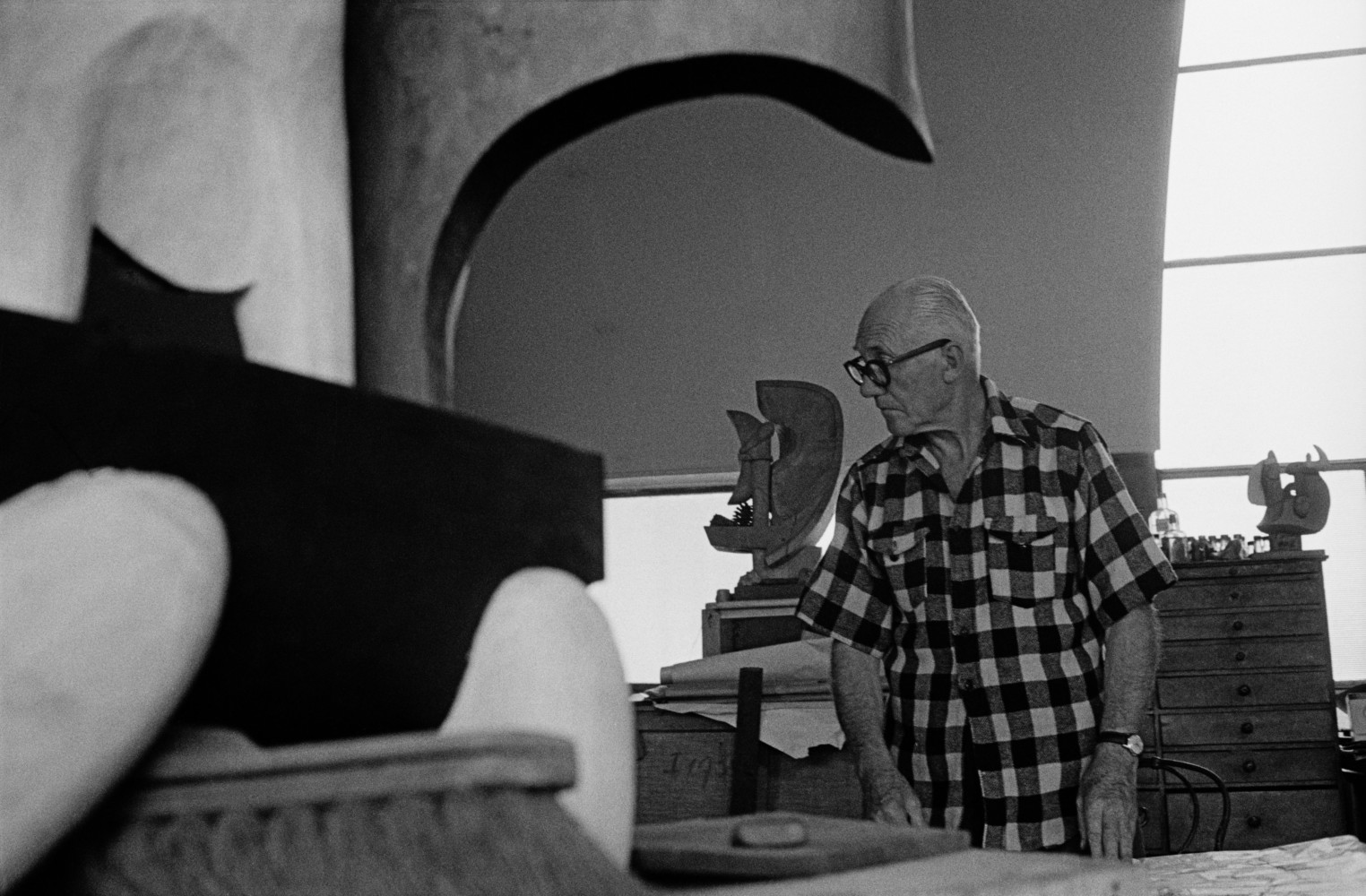
However, Le Corbusier’s private life was far from conventionally monogamous. Throughout his marriage, he engaged in several high-profile extra-marital affairs. In 1929, while traveling back from South America aboard an ocean liner, he met the famed American-born entertainer and international superstar Josephine Baker. Entranced by her charisma, he produced a series of nude sketches of her during the voyage, sparking an affair that fascinated cultural circles. He also maintained a long-term romantic relationship with Marguerite Tjader Harris, an American heiress and author. Away from the drawing board, Le Corbusier sought solace in painting and sculpting, spending hours every morning in his private studio, far removed from architecture. In his later years, he spent his summers in a tiny, meticulously designed 14-square-meter wooden cabin called the Cabanon de vacances at Roquebrune-Cap-Martin on the French Riviera, living an minimalist lifestyle next to the sea.

5. High-Stakes Controversies, Literary Debates & Overcoming Adversity
Historical Scrutiny: Charles-Édouard Jeanneret-Gris and His Engagement with the Vichy Regime
While celebrated for decades as a progressive visionary who sought to liberate urban populations through clean air and sunlight, Le Corbusier’s legacy faced intense critical scrutiny in the 21st century regarding his radical political alliances and fascist sympathies. In 2015, on the 50th anniversary of his death, the publication of three groundbreaking investigative books in France—by authors Marc Perelman, Xavier de Jarcy, and François Chaslin—ignited an international media storm and architectural scandal. The scholars presented exhaustive archival evidence demonstrating that Le Corbusier was actively involved in far-right political networks during the 1920s and 1930s.
The disclosures revealed that he had served as an editor for fascist-leaning journals such as Plans and Prélude, associated closely with Georges Valois’s fascist party Le Faisceau, and expressed overt antisemitic views in private letters to his mother. Furthermore, following the fall of France in 1940, Le Corbusier relocated to Vichy, actively courting the authoritarian, Nazi-collaborating Vichy regime under Marshal Philippe Pétain for over eighteen months. He accepted an official position on a government urban planning committee, hoping the totalitarian state would grant him absolute power to execute his radical city redevelopments. When the Centre Pompidou hosted a major retrospective in Paris in 2015 that omitted any mention of his wartime politics, critics accused the French cultural establishment of whitewashing history. While defenders argue that Le Corbusier was an opportunistic technocrat who pursued any authority willing to fund his architectural visions regardless of ideology, the controversy permanently shattered his unblemished image as a pure humanist.
Urban Renewal Ideology: The 1925 Plan Voisin and Radiant City Proposals by Charles-Édouard Jeanneret-Gris
Beyond his political associations, Le Corbusier’s urban planning doctrines sparked decades of intense public debate and professional criticism. In 1925, sponsored by an automobile manufacturer, he presented the infamous Plan Voisin for Paris. The proposal called for the total demolition of a massive swath of historic central Paris north of the Seine—wiping away historic neighborhood streets and centuries-old architecture—to be replaced by eighteen identical 60-story cruciform glass-and-steel skyscrapers set inside vast manicured parklands and crisscrossed by high-speed arterial highways.
Although French authorities rejected the Plan Voisin, Le Corbusier’s dogmatic insistence on tabula rasa urban renewal—destroying historic street fabrics in favor of isolated towers and car-centric infrastructure—exerted an overwhelming influence on post-WWII public housing projects across Europe and North America. By the late 1960s and 1970s, urban theorists like Jane Jacobs and public critics fiercely condemned his principles. Critics pointed out that his ‘skyscrapers in the park’ frequently degenerated into isolated, soul-crushing concrete high-rises surrounded by parking lots, breeding social isolation, community breakdown, and urban decay. Additionally, private structural controversies plagued his career; early clients, including the owners of the Villa Savoye, famously complained of chronic roof leaks and structural defects, even threatening legal action before WWII intervened.

6. Literary Voice, Conceptual Framework & Cultural Resonance
Le Corbusier was not merely an architect; he was a master brand-builder and stylistic icon who intuitively understood the power of media, fashion, and personal identity decades before the digital age. His personal aesthetic—sharp dark suits, bowties, impeccably slicked hair, and heavy round black horn-rimmed glasses—became the ultimate archetype of the modern architect, an iconic image still emulated by design professionals worldwide. His keen eye for visual presentation extended to photography, typography, and book design, ensuring that his architectural manifestos read with the visual pop of modern advertising.
Although Le Corbusier passed away decades before the dawn of the internet, his cultural imprint across contemporary social media is colossal. Design enthusiasts, architecture students, and luxury aesthetic accounts continuously generate millions of impressions on Instagram, TikTok, and Pinterest surrounding his work. Content featuring his LC4 lounger, brutalist textures, the vibrant walls of Unité d’Habitation, and interior tours of Villa Savoye garners immense digital engagement. His official legacy is diligently maintained by the Fondation Le Corbusier in Paris, which protects his intellectual property, archives his original drawings, and manages his preserved buildings for public tours.
7. Upcoming Manuscripts, Museum Installations & Future Horizons
On August 27, 1965, at the age of 77, Le Corbusier passed away while taking his daily morning swim in the Mediterranean Sea off the coast of Roquebrune-Cap-Martin, France, having suffered a sudden heart attack. His international state funeral was held in the courtyard of the Louvre Museum in Paris, with French Minister of Culture André Malraux delivering a famous eulogy declaring that Le Corbusier had achieved a global transformation unmatched in architectural history. He was laid to rest alongside his wife Yvonne in the cemetery overlooking Roquebrune.
Decades after his death, interest in Le Corbusier’s work continues to grow across academic, artistic, and preservationist frontiers. The Fondation Le Corbusier regularly collaborates with UNESCO and global institutions to execute ongoing conservation initiatives on his World Heritage structures. Retrospectives exploring his multifaceted work as a painter, sculptor, furniture designer, and author continue to tour major global museums, while architectural schools worldwide continue to debate his revolutionary—and controversial—vision of human living spaces.
Charles-Édouard Jeanneret-Gris FAQs: Key Questions Answered
How old was Le Corbusier when he passed away?
Le Corbusier was born on October 6, 1887, and died on August 27, 1965, at the age of 77.
Who was Le Corbusier married to?
Le Corbusier married Monegasque model Yvonne Gallis in 1930. They remained married until her death in 1957.
What is Le Corbusier’s most famous architectural work?
His most world-famous works include the Villa Savoye in Poissy, the Unité d’Habitation in Marseille, the Chapelle Notre-Dame du Haut in Ronchamp, and the master plan for Chandigarh, India.
What accolades and honors did Le Corbusier receive?
He was awarded the AIA Gold Medal in 1961, made a Grand Officier of the Légion d’honneur in 1964, and had 17 of his buildings designated as UNESCO World Heritage sites in 2016.