
Gabrielle Bonheur Chanel: Aubazine Monastery Roots, Seamstress Origins, and Cabaret Beginnings
The woman who would rewrite the visual lexicon of modern womanhood was born into dire poverty as Gabrielle Bonheur Chanel on August 19, 1883, in Saumur, France. Her birth took place in a charity hospital run by the Sisters of Providence, recorded under humble circumstances as the daughter of Eugénie Jeanne Devolle, a frail laundrywoman, and Albert Chanel, an itinerant street vendor who peddled work clothes and underwear. Growing up in crowded, impoverished lodgings, Gabrielle’s early childhood was defined by instability, nomadic movement, and emotional neglect. When she was just eleven years old, her mother succumbed to tuberculosis and severe exhaustion at age thirty-one. Incapable of caring for his children, Albert Chanel abandoned his two sons to farm labor and deposited his three young daughters—Gabrielle, Julia, and Antoinette—at the Aubazine Convent orphanage in central France.
While the cold, austere environment of the Cistercian monastery was traumatic for the young girl, Aubazine proved to be the crucible where her future genius was forged. The nuns taught Gabrielle rigorous seamstress skills, precision embroidery, and delicate needlework—technical foundations that would dictate her life’s work. More importantly, the stark, minimalist aesthetic of the convent profoundly shaped her artistic eye. The plain black-and-white habits of the nuns, the clean geometry of Romanesque archways, stained glass windows featuring interconnected floral motifs, and unadorned stone floors laid the visual groundwork for what would eventually become the signature Chanel palette and logo. At eighteen, upon reaching the age limit at Aubazine, Chanel moved to a boarding house for Catholic girls in Moulins, where she took a job as a seamstress for local tailors while harboring secret ambitions for the stage.
During her time in Moulins, Chanel began singing in local cafes and cabaret halls frequented by French cavalry officers, notably La Rotonde. Her modest repertoire included two popular cabaret tunes: “Ko Ko Ri Ko” and “Qui qu’a vu Coco?”—a playful story about a lost dog in Trocadéro. The admiring military officers soon dubbed her ‘Coco’, a moniker that would forever supersede her baptismal name. Though her vocal abilities were modest and her dreams of becoming a professional stage performer quickly waned, the cabaret circuit altered her destiny by introducing her to wealthy aristocratic patrons who possessed the financial capital and social connections necessary to launch her into elite French society.

Gabrielle Bonheur Chanel Launches Chanel Modes in Paris with Étienne Balsan Capital
In 1906, Coco Chanel captured the affection of Étienne Balsan, a wealthy young French textile heir and ex-cavalry officer. Moving into his lavish château at Royallieu near Compiègne, Chanel was thrust into a world of decadent luxury, thoroughbred horses, and high-society galas. Refusing to conform to the ostentatious, hyper-feminine fashions of the Belle Époque—which forced women into suffocating S-curve corsets, towering feather-laden hats, and restrictive petticoats—Chanel began altering menswear, riding trousers, and minimalist boater hats for her own wardrobe. Her understated, effortless aesthetic immediately captivated the aristocratic women visiting Balsan’s estate, who begged her to craft similar hats for them.
Recognizing her unique artistic eye, Balsan offered Chanel his bachelor apartment in Paris to open a modest millinery workshop in 1909. Shortly thereafter, Chanel fell deeply in love with Balsan’s wealthy English friend, Captain Arthur Edward ‘Boy’ Capel. Capel saw in Chanel not merely a muse, but a brilliant business strategist. He financed her first official commercial boutique, Chanel Modes, opened in 1910 at 21 Rue Cambon in Paris. Located near the Place Vendôme, the shop quickly became a magnet for famous French theater actresses, including Gabrielle Dorziat, who wore Chanel’s hats in stage productions and fashion magazines. By 1912, Chanel Modes was a resounding commercial hit.
Emboldened by her Parisian success, Chanel expanded her business with financial backing from Capel, opening a seaside boutique in Deauville in 1913, followed by a couture house in Biarritz in 1915. In Deauville, she made a revolutionary move that redefined fashion history: she began designing garments made from jersey cloth. At the time, jersey was an inexpensive, flexible knit fabric used almost exclusively for men’s winter underwear. Chanel embraced jersey for its fluid drape, comfort, and freedom of movement, creating relaxed suits, sailor sweater tunics, and unstructured dresses that catered to women seeking practical, elegant clothing during the social upheavals of World War I. By 1919, Chanel was officially registered as a couturière and established her legendary flagship house at 31 Rue Cambon, Paris, laying the groundwork for an international luxury empire.
Gabrielle Bonheur Chanel Redefines Modern Fashion with Deauville Boutiques and Jersey Fabrics
Gabrielle Bonheur Chanel Debuts the Little Black Dress, Chanel No. 5, and the 2.55 Handbag
The 1920s marked Chanel’s transformation from a prominent Parisian dressmaker into an international cultural powerhouse. Her aesthetic was the antithesis of Paul Poiret’s dramatic, orientalist drapery; Chanel championed a sleek, athletic, and functional silhouette that mirrored the liberated spirit of the ‘Flapper’ or ‘Garçonne’ era. In 1921, Chanel disrupted the fragrance industry by launching Chanel No. 5. Created in collaboration with former Russian imperial perfumer Ernest Beaux, Chanel No. 5 was groundbreaking on multiple fronts. Unlike traditional Victorian fragrances that relied on single floral scents like rose or jasmine, Beaux utilized synthetic aldehydes to create a complex, multi-layered, abstract fragrance profile. Furthermore, Chanel presented the liquid in a austere, crystal-clear rectangular bottle resembling a laboratory flask or whiskey decanter, topped with an octagonal stopper inspired by the layout of Paris’s Place Vendôme.
Chanel No. 5 became an instant global sensation, generating unprecedented profit margins and solidifying the Chanel brand’s status across Europe and the Americas. Building on this monumental triumph, Chanel introduced another revolutionary cultural staple in October 1926: the Little Black Dress (LBD). Published as a sketch in American Vogue, the simple, knee-length black crepe dress featuring long slender sleeves was hailed by editors as ‘Chanel’s Ford’—referencing Henry Ford’s Model T. Vogue correctly predicted that the versatile dress, stripped of extraneous ruffles and excess decoration, would become a universal uniform for modern women of all social classes. Prior to Chanel, black was strictly reserved for mourning or domestic servants; Chanel transformed it into the ultimate symbol of chic, rebellious sophistication.
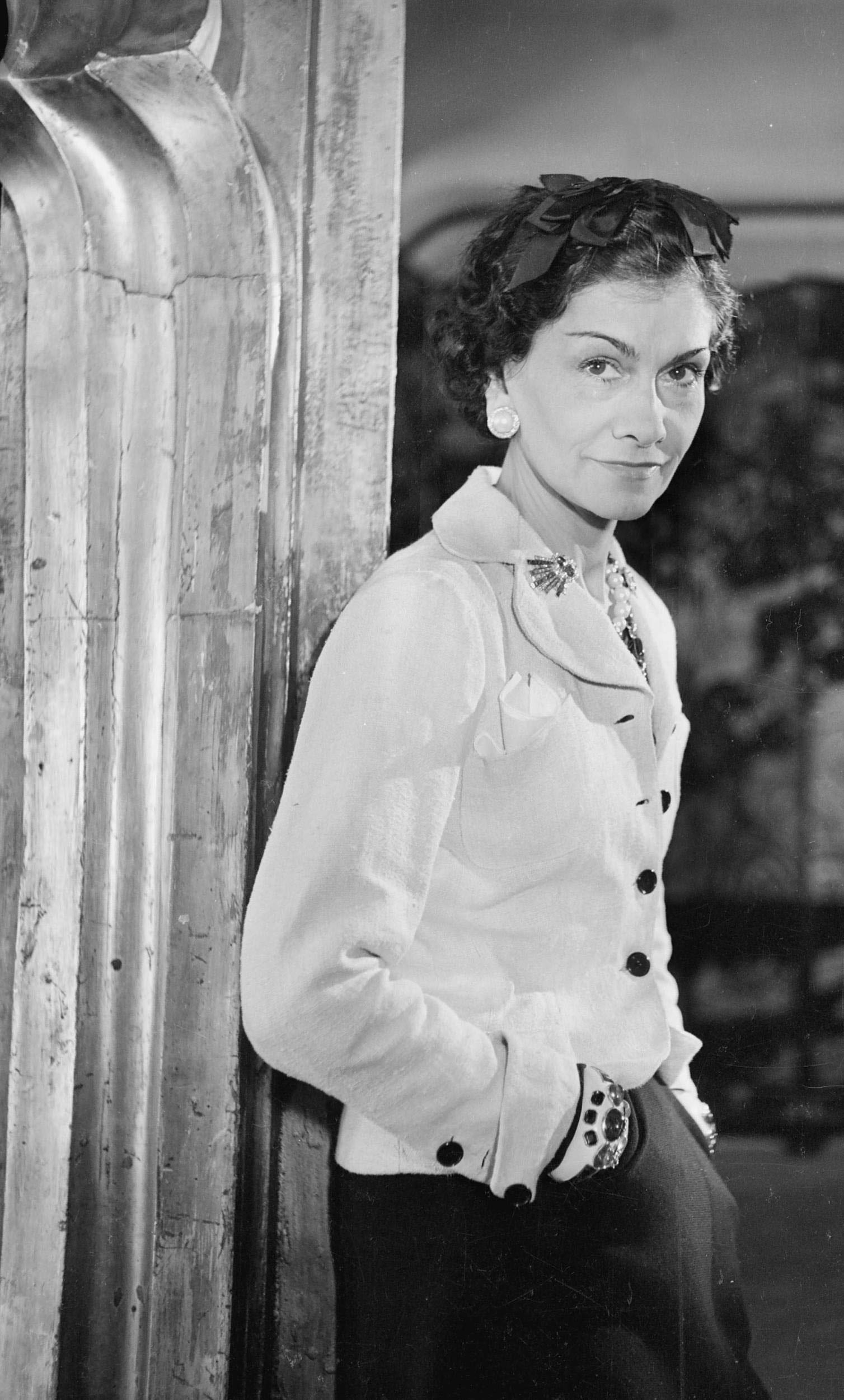
Gabrielle Bonheur Chanel Partners with Pierre Wertheimer to Form Parfums Chanel
Throughout the late 1920s and 1930s, Chanel’s House at 31 Rue Cambon expanded into an immense enterprise employing over 4,000 workers across twenty ateliers, producing over 28,000 garments annually. Her creative universe expanded to encompass costume jewelry, cosmetics, and accessories. Recognizing that high fashion was often financially inaccessible, Chanel popularized high-end costume jewelry by pairing oversized fake pearls, poured-glass brooches, and synthetic rubies with fine gemstones—arguing that jewelry was meant to adorn a costume rather than display ostentatious wealth.
Her global footprint caught the attention of Hollywood mogul Samuel Goldwyn, who in 1931 offered Chanel a staggering $1 million contract (equivalent to tens of millions today) to travel to Los Angeles twice a year and design wardrobes for United Artists stars, including Gloria Swanson, Greta Garbo, and Marlene Dietrich. While Chanel found Hollywood’s sensationalism distasteful and felt studio executives prioritized cinematic splash over genuine elegance, her work on films like Tonight or Never (1931) left an indelible mark on cinematic glamour. Back in Paris, Chanel reached the absolute peak of her pre-war artistic influence, rivaling surrealist designers like Elsa Schiaparelli and maintaining close personal and artistic collaborations with avant-garde icons like Pablo Picasso, Jean Cocteau, Igor Stravinsky, and Sergei Diaghilev of the Ballets Russes, for whom she designed revolutionary stage costumes.

Gabrielle Bonheur Chanel Built a High-Fashion House That Revolutionized Modern Womenswear
When World War II broke out in 1939, Chanel abruptly closed her haute couture fashion house, dismissing thousands of employees and keeping open only her boutique at Rue Cambon to sell perfumes and accessories. She remained out of the creative limelight for fifteen years. However, in 1954, at the age of seventy-one, Chanel made an unprecedented, high-stakes return to haute couture. Disturbed by the dominant postwar silhouette championed by Christian Dior’s 1947 ‘New Look’—which Chanel viewed as patriarchal, retrograde, and restrictive with its padded hips, corseted waists, and heavy petticoats—she sought to re-liberate women.
Her comeback collection debuted on February 5, 1954, to initial disdain from French fashion critics, who viewed her designs as outdated relics of the 1930s. However, British and American press, led by Vogue and Harper’s Bazaar, embraced her new masterwork: the Chanel Suit. Consisting of a collarless, boxy tweed jacket trimmed with braided ribbon, fitted with gold-toned buttons, and paired with a simple, comfortable A-line skirt, the suit was lined with silk and weighted at the interior hem with a delicate brass chain to ensure perfect drape. In February 1955, she introduced the iconic 2.55 Quilted Handbag, crafted with a leather-intertwined chain shoulder strap that freed women’s hands from handheld clutches. In 1957, Chanel received the prestigious Neiman Marcus Fashion Award in Dallas, Texas, officially honoring her as the most influential fashion creator of the 20th century.
Gabrielle Bonheur Chanel: Romances with Boy Capel, the Duke of Westminster, and French Aristocracy
Despite her immense fame and status as one of the world’s wealthiest self-made women, Coco Chanel’s personal life was characterized by romantic turmoil, deep tragedy, and intense solitude. She never married, famously remarking when asked why she rejected marriage proposals from nobility: “There have been several Duchesses of Westminster, but there is only one Chanel.” Her first profound love was Captain Arthur ‘Boy’ Capel. Their passionate nine-year affair ended in devastating tragedy in December 1919, when Capel was killed in a violent automobile accident on his way to join Chanel for Christmas. Capel’s death plunged Chanel into profound grief, and she later admitted that his loss stripped away her capacity for emotional vulnerability, driving her to channel all her energy into her business empire.
In the 1920s, Chanel embarked on a series of high-profile romantic relationships with some of Europe’s most influential aristocrats and creators. She had a passionate romance with Grand Duke Dmitri Pavlovich of Russia, a cousin of Tsar Nicholas II, who introduced her to exiled Russian royalty, traditional imperial embroidery techniques, and perfumer Ernest Beaux. Later, she began an extraordinary six-year relationship with Hugh Grosvenor, the 2nd Duke of Westminster—one of the richest men in the world. Spending time at his Scottish estates, Chanel incorporated his tweed jackets, sporting waistcoats, and Scottish wools directly into her womenswear collections.
Chanel had no biological children of her own, but she maintained complex, maternal relationships with her family. Following the suicide of her sister Julia, Chanel raised and legally adopted her nephew, André Palasse, providing him with elite boarding school educations, luxury homes, and medical care throughout his life. Away from her atelier, Chanel lived a fiercely guarded, decadent lifestyle. For over thirty years, her primary residence was a lavish private suite at the Hôtel Ritz in Paris, overlooking Place Vendôme, directly across from her Rue Cambon workshop. She was an avid art collector, literary patron, equestrian, and reader whose private apartment above her salon was filled with rare Coromandel lacquer screens, rock crystal chandeliers, and gilded lion sculptures representing her astrological sign, Leo.

Gabrielle Bonheur Chanel: Hotel Ritz Residence, Wartime Controversies, and Swiss Exile
Gabrielle Bonheur Chanel and Abwehr Agent Hans Günther von Dincklage in Operation Modellhut
The most catastrophic and heavily documented controversy in Coco Chanel’s life involves her actions during the German occupation of France in World War II. When Nazi forces occupied Paris in June 1940, Chanel took up residence at the Hôtel Ritz Paris, which served as the official headquarters for high-ranking German military personnel and diplomats. During this period, Chanel began an intimate romantic affair with Baron Hans Günther von Dincklage, a handsome German officer and operative for the Abwehr (German military intelligence), affectionately known in Parisian high society as ‘Spatz’.
Declassified archival documents released in the 21st century—most notably exposed in Hal Vaughan’s 2011 biographical investigation Sleeping with the Enemy—revealed that Chanel was formally recruited into the Abwehr as Agent F-7124, codenamed ‘Westminster’. In late 1943, Chanel participated in a secret German intelligence mission titled Operation Modellhut (‘Model Hat’). Leveraging her past romantic connection to British Prime Minister Winston Churchill, Chanel traveled to Madrid alongside her friend Vera Bate Lombardi under the guise of diplomatic business, carrying a personal letter intended for Churchill to negotiate a separate peace between Nazi Germany and Britain. The mission failed when Lombardi exposed Chanel and her German handler as Nazi operatives to the British Embassy in Madrid.
Simultaneously, Chanel attempted to utilize Nazi Aryanization laws to seize full control of her fragrance company, Parfums Chanel. In 1924, Chanel had partnered with Jewish businessmen Pierre and Paul Wertheimer to mass-manufacture and distribute Chanel No. 5, taking a 10% royalty stake while the Wertheimers held 70%. In May 1941, Chanel petitioned Nazi occupation authorities to confiscate the Wertheimers’ corporate assets, claiming the business was ‘abandoned’ Jewish property. However, the Wertheimers had anticipated her move and legally transferred their ownership shares to a Christian French businessman, Félix Amiot, frustrating Chanel’s predatory attempt to expropriate the company.
Gabrielle Bonheur Chanel: Post-War Swiss Exile, Parfums Chanel Disputes, and the 1954 Paris Comeback
In September 1944, immediately following the Liberation of Paris, Chanel was arrested at the Hôtel Ritz by the Forces Françaises de l’Intérieur (FFI) and interrogated by the French purge committee regarding her collaboration with Nazi military intelligence. However, after just a few hours of questioning, Chanel was released without charge. Historical evidence strongly indicates that Winston Churchill personally intervened through diplomatic channels to prevent Chanel’s prosecution, fearing her trial would expose high-level British aristocratic connections to Nazi sympathizers.
Aware of the seething hostility of the French public—who despised women accused of ‘horizontal collaboration’—Chanel immediately fled France and entered a decade of self-imposed exile in Lausanne, Switzerland. During her Swiss exile, she engaged in intense corporate warfare with Pierre Wertheimer. Realizing that Chanel’s creative image was essential to keeping Chanel No. 5 profitable, Wertheimer reached a historic, highly lucrative settlement with her in 1947. He agreed to pay Chanel $400,000 in wartime profits, a ongoing 2% royalty on all global Chanel No. 5 sales, and funded her extravagant living expenses for the remainder of her life, making her one of the richest women in Europe.
When Chanel returned to Paris in 1954 to relaunch her fashion house, French media and consumers initially boycotted her collection due to her wartime record. However, Chanel successfully bypassed French hostility by targeting the American market. American women, unburdened by European wartime trauma, fell in love with her comfortable tweed suits. By the late 1950s, Chanel had effectively rehabilitated her public image through sheer commercial brilliance and design dominance, proving that her artistic utility outweighed public moral outrage.

Gabrielle Bonheur Chanel: Tailored Tweed Suits, Minimalist Aesthetics, and Haute Couture Mastery
Coco Chanel’s aesthetic legacy redefined modern female empowerment through fashion. Before Chanel, luxury was defined by excess ornament, physical restriction, and visible wealth. Chanel inverted this philosophy by introducing the concept of ‘poverty deluxe’—finding luxury in simplicity, impeccable tailoring, ease of motion, and pristine fabrics. She dismantled the traditional boundaries between menswear and womenswear, borrowing tweed, trousers, polo collars, and naval striped shirts (the Breton top) to construct a revolutionary wardrobe for the modern, independent woman.
Because Coco Chanel passed away in 1971—decades before the digital revolution—she holds no personal social media footprint or active profiles on modern platforms like Instagram, X (Twitter), Facebook, or YouTube. However, her digital cultural stature remains immense. The official luxury house she founded, @CHANEL, commands over 50 million Instagram followers and millions more across digital channels, maintaining her iconic double-C logo as a global symbol of prestige. Her life has been immortalized in major cinematic works, including Coco Before Chanel (2009 starring Audrey Tautou) and Coco Chanel & Igor Stravinsky (2009), as well as the 1969 Broadway musical Coco starring Katharine Hepburn.
Gabrielle Bonheur Chanel: Patronage of Igor Stravinsky, Ballets Russes Costumes, and Artistic Legacy
Coco Chanel passed away peacefully in her sleep on Sunday, January 10, 1971, at the age of eighty-seven in her apartment at the Hôtel Ritz Paris. Her final words to her maid, Célestine, were reportedly: “You see, this is how you die.” Her funeral at the Église de la Madeleine was attended by fashion elite, with models sitting in the front rows dressed in her famous tweed suits. She was buried in the Bois-de-Vaux Cemetery in Lausanne, Switzerland, under a tombstone designed by Chanel herself featuring five sculpted lions—symbolizing her zodiac sign and her superstitious nature.
Today, the House of Chanel continues to thrive as a privately held, multi-billion-dollar luxury behemoth owned by Gerard and Alain Wertheimer—the grandsons of her original business partner Pierre Wertheimer. Following her death, the house was creatively directed by design titans like Karl Lagerfeld (1983–2019) and Virginie Viard (2019–2024), who consistently drew inspiration from Chanel’s foundational codes: the tweed suit, the little black dress, pearls, camellia flowers, quilted leather, and Chanel No. 5. Chanel’s historical legacy endures as the ultimate testament to how a single self-made visionary can forever transform global culture.
Gabrielle Bonheur Chanel FAQs: Key Questions Answered
How old was Coco Chanel when she died?
Coco Chanel passed away at the age of 87 on January 10, 1971, at her private residence in the Hôtel Ritz Paris.
Was Coco Chanel ever married or did she have children?
Coco Chanel was never married and had no biological children. However, she had several famous romances with high-profile figures such as Boy Capel and the Duke of Westminster, and she raised her nephew, André Palasse.
What is Coco Chanel’s most famous fashion creation?
Coco Chanel is legendary for several revolutionary creations, most notably Chanel No. 5 perfume (1921), the Little Black Dress (1926), the iconic Chanel Tweed Suit (1954), and the 2.55 Quilted Handbag (1955).
Was Coco Chanel really a Nazi spy during World War II?
Yes. Declassified military intelligence archives confirm that Coco Chanel was recruited by the German Abwehr during the Nazi occupation of Paris as Agent F-7124 (codenamed ‘Westminster’). She participated in Operation Modellhut in 1943, though she avoided post-war prosecution through intervention from high-level political figures including Winston Churchill.


