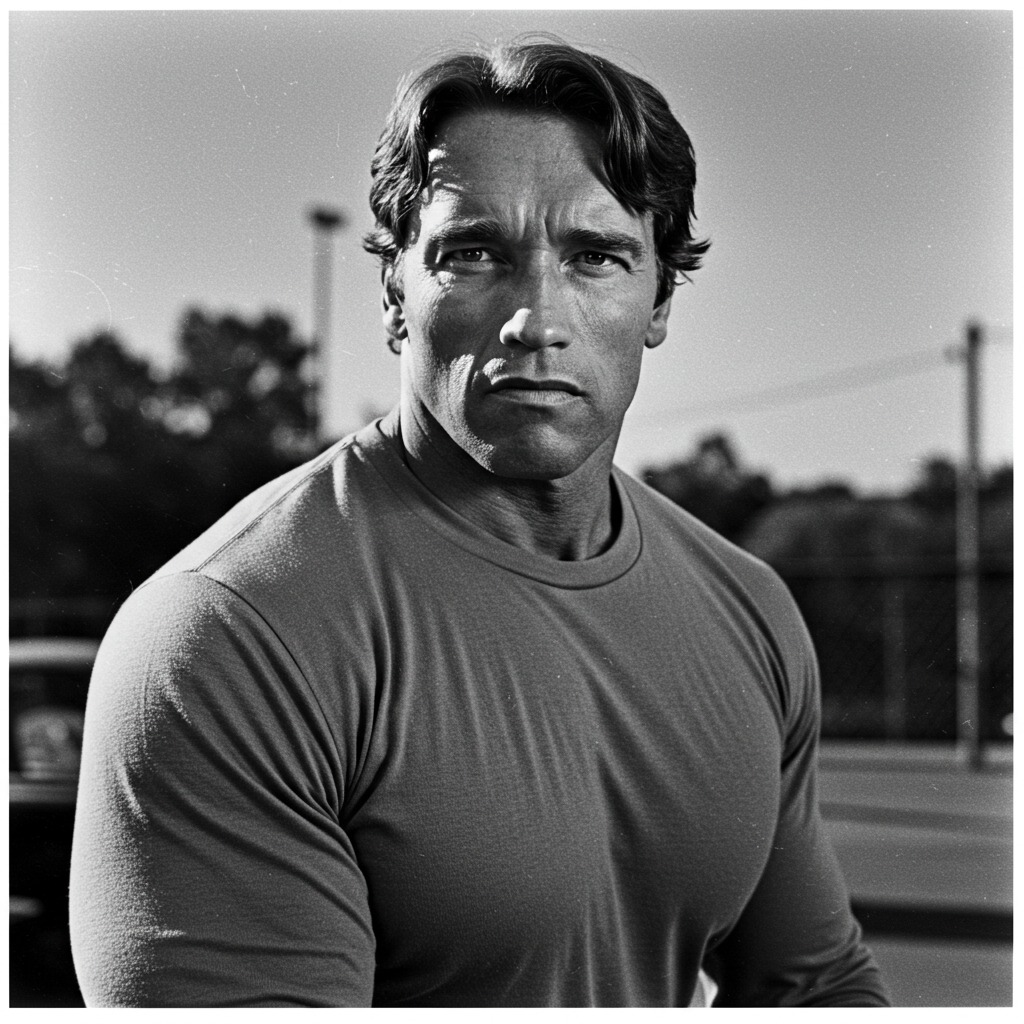
From Thal to Stuttgart: How Young Arnold Alois Schwarzenegger Built an Iron Empire
Arnold Alois Schwarzenegger was born on July 30, 1947, in the quiet village of Thal, Austria, a small community bordering the Styrian capital of Graz. Raised in the shadow of World War II, his childhood was defined by austere conditions, rigid Catholic discipline, and a complex relationship with his father, Gustav Schwarzenegger, a local police chief who had served as a military policeman during the war. Gustav’s strict, authoritarian parenting style often pitted Arnold against his older brother, Meinhard, fostering an environment of intense athletic competition. Despite the emotional strain and physical hardship of his upbringing, young Arnold channeled his frustration into ambition, dreaming of a life far beyond the borders of rural Austria.
Schwarzenegger was an active athlete in his youth, participating in soccer, track and field, and swimming. However, a pivotal turning point arrived in 1960 when his soccer coach took the team to a local gymnasium in Graz. Introduced to barbells and heavy resistance training, the thirteen-year-old Arnold experienced an epiphany. He abandoned team sports to focus entirely on body conditioning, drawn to the idea of sculpting his physique into an indestructible fortress. Inspired by bodybuilders-turned-actors such as Reg Park, Steve Reeves, and Johnny Weissmuller, he recognized physical bodybuilding not merely as a sport, but as his passport to international stardom and the American Dream.
By age fourteen, Schwarzenegger was dedicated to an grueling daily regimen. His obsession with weightlifting was so intense that he was known to break into the Graz gymnasium on weekends when it was closed. In 1965, while fulfilling his mandatory one-year military service in the Austrian National Guard, he went AWOL to compete in the Junior Mr. Europe contest in Stuttgart, Germany. Schwarzenegger won the championship, though his unauthorized absence earned him a brief stay in a military prison. Far from discouraging him, the victory cemented his resolve. Upon his discharge, he moved to Munich, working at a health club while training furiously to enter the world stage of competitive bodybuilding.

Dominating Mr. Universe and Mr. Olympia: Arnold Alois Schwarzenegger Conquers Bodybuilding
Schwarzenegger’s rapid ascent in the bodybuilding arena quickly caught the attention of the international fitness community. In 1966, at just nineteen years old, he placed second in the prestigious Mr. Universe competition in London, astounding judges with his unprecedented muscle volume and symmetry. Returning the following year in 1967, he captured the Mr. Universe title, becoming the youngest person in history to achieve the feat at age twenty. His victories in Europe attracted the interest of Joe Weider, the visionary publisher and co-founder of the International Federation of Bodybuilders (IFBB), who invited Schwarzenegger to move to the United States to train among the world’s elite in Santa Monica, California.
Arriving in America in October 1968 with limited English proficiency and little money, Schwarzenegger adjusted rapidly to Southern California’s Gold’s Gym culture. Under Weider’s mentorship, he refined his conditioning and presentation, capturing consecutive Mr. Universe titles. In 1970, at age twenty-three, he won his first Mr. Olympia title in New York City, defeating defending champion Sergio Oliva. Schwarzenegger went on to dominate the sport, winning six consecutive Mr. Olympia titles from 1970 to 1975, transforming bodybuilding from a niche subculture into a mainstream athletic phenomenon.
Determined to transition into Hollywood acting, Schwarzenegger faced formidable skepticism from talent agents and studio executives who dismissed his massive frame, unpronounceable surname, and thick Austrian accent. Undeterred, he landed his feature film debut in the low-budget comedy Hercules in New York (1970), credited under the pseudonym “Arnold Strong” with his dialogue dubbed by an American actor. His breakthrough as a cinematic performer came with the landmark 1977 bodybuilding documentary Pumping Iron. The film showcased Schwarzenegger’s charisma, psychological warfare, and screen presence, introducing him to mainstream moviegoers and critics alike, and winning him the Golden Globe Award for New Star of the Year for his dramatic role in Stay Hungry (1976).
The Terminator and Conan: Arnold Alois Schwarzenegger Rewrites Hollywood Action Cinema
From Conan the Barbarian to T-800: Arnold Alois Schwarzenegger’s Iconic Filmography
The trajectory of Schwarzenegger’s cinematic career shifted dramatically when director John Milius cast him as the title character in Conan the Barbarian (1982). Adapted from Robert E. Howard’s pulp fantasy stories, the film capitalized on Schwarzenegger’s massive physique and intense physical performance. The movie grossed over $79 million worldwide, proving that he could headline a major theatrical release. He reprised the role in the 1984 sequel Conan the Destroyer, establishing himself as a reliable box office draw in the action fantasy space.
In 1984, Schwarzenegger secured his place in pop culture history when director James Cameron cast him as the title villain in the sci-fi thriller The Terminator. Playing a relentless cybernetic assassin sent back in time, Schwarzenegger delivered a chilling, economical performance anchored by the iconic catchphrase, “I’ll be back.” Produced on a modest budget of $6.4 million, the film grossed over $78 million globally, receiving critical acclaim and establishing Schwarzenegger as an action lead capable of carrying high-concept genre cinema.
Throughout the mid-to-late 1980s, Schwarzenegger reaped a string of major commercial hits that cemented his box office authority. High-octane action vehicles such as Commando (1985), Raw Deal (1986), and The Running Man (1987) thrilled global audiences. In 1987, he starred in John McTiernan’s sci-fi horror masterpiece Predator, playing Major Alan “Dutch” Schaefer. The film became an overwhelming commercial and critical success, earning over $98 million worldwide and cementing his status alongside Sylvester Stallone as a dominant force in 1980s Hollywood action cinema.

Predator, Total Recall, and James Cameron: Arnold Alois Schwarzenegger’s Box Office Hegemony
As the decade turned, Schwarzenegger expanded his artistic range by venturing into studio comedies, disproving industry claims that his persona was strictly limited to action. Teaming up with director Ivan Reitman and co-star Danny DeVito in Twins (1988), he played the refined, naive brother of DeVito’s street-smart character. The comedy was a colossal financial triumph, earning more than $216 million worldwide on a modest budget. Schwarzenegger followed this success with 1990’s Kindergarten Cop, which grossed over $202 million, demonstrating his broad appeal across family demographics.
Schwarzenegger reached the pinnacle of his cinematic power in 1991 with James Cameron’s revolutionary sci-fi masterpiece Terminator 2: Judgment Day. Subverting expectations by re-imagining the T-800 as a protective hero, the film pushed the boundaries of visual effects and action choreography. T2 shattered box office records, becoming the highest-grossing film of 1991 with a global take exceeding $520 million. It received four Academy Awards and defined the blockbuster blockbuster landscape of the 1990s.
His streak of cinematic dominance continued with Paul Verhoeven’s sci-fi thriller Total Recall (1990), which earned $261 million globally, and James Cameron’s action-comedy blockbuster True Lies (1994), co-starring Jamie Lee Curtis. True Lies grossed over $378 million worldwide, showcasing Schwarzenegger’s ability to blend comedic timing with large-scale action sequences. By the mid-1990s, Schwarzenegger was commanding record-setting salary quotes of $20 million to $25 million per film, plus back-end profit participation, making him one of the highest-paid entertainers in Hollywood history.

Golden Globes and Screen Stature: Arnold Alois Schwarzenegger’s Evolution into a Global Superstar
Toward the late 1990s, Schwarzenegger navigated shifting cinematic tastes and health challenges, undergoing elective heart surgery in 1997 to replace a defective aortic valve. He continued to headline major studio productions, including Eraser (1996), the big-budget superhero film Batman & Robin (1997)—in which he played the tragic villain Mr. Freeze—and the apocalyptic thriller End of Days (1999). In 2003, he returned to his landmark franchise with Terminator 3: Rise of the Machines, securing a staggering $29 million salary and earning praise for his physical dedication at age fifty-five.
In a historic pivot, Schwarzenegger paused his active screen career in late 2003 after winning the California gubernatorial recall election. Serving two consecutive terms as the 38th Governor of California from 2003 to 2011, he led the state through complex fiscal crises, legislative reform, and global climate initiatives, including the groundbreaking Global Warming Solutions Act of 2006 (AB 32).
Following his political tenure, Schwarzenegger launched a successful Hollywood comeback in the 2010s. He joined Sylvester Stallone’s ensemble action franchise The Expendables (2010–2014), starred in the action feature The Last Stand (2013), and teamed up with Stallone for the thriller Escape Plan (2013). Demonstrating dramatic growth, he delivered critically praised performances in indie projects such as the post-apocalyptic drama Maggie (2015) and the revenge drama Aftermath (2017). He returned to his iconic role in Terminator Genisys (2015) and Terminator: Dark Fate (2019), before making his scripted television debut in the action-comedy series FUBAR (2023–2025).
The Shriver-Kennedy Alliance: Inside Arnold Alois Schwarzenegger’s High-Society Marriage
Schwarzenegger’s personal life has long been a subject of intense public fascination. In the late 1960s and early 1970s, during his rise in the bodybuilding world, he engaged in a high-profile relationship with Barbara Outland, an English teacher with whom he lived until their separation in 1975. He later dated hairdresser Sue Moray in the late 1970s. However, his romantic trajectory changed permanently in August 1977 when he met television journalist Maria Shriver—the daughter of Peace Corps founder Sargent Shriver and Eunice Kennedy Shriver, sister of President John F. Kennedy—at a celebrity tennis tournament.
Schwarzenegger and Shriver began a prominent romance that bridged Hollywood glamour with American political royalty. The couple married on April 26, 1986, in a high-profile ceremony at St. Francis Xavier Church in Hyannis, Massachusetts. Together, they made their home in the Brentwood area of Los Angeles and had four children: Katherine Eunice Schwarzenegger (born 1989), Christina Maria Aurelia Schwarzenegger (born 1991), Patrick Arnold Shriver Schwarzenegger (born 1993), and Christopher Sargent Shriver Schwarzenegger (born 1997). Their family dynamic was frequently showcased in media profiles, presenting a blend of Hollywood success, bipartisan civic engagement, and philanthropic endeavors.
In addition to his immediate family, Schwarzenegger became a father-in-law when his eldest daughter, Katherine, an accomplished author, married film actor Chris Pratt in 2019. Beyond acting and public service, Schwarzenegger maintains private passions including real estate investment, classical weight training, equestrian pursuits, and animal advocacy, housing a famous collection of miniature pets—including a donkey named Lulu and a miniature horse named Whiskey—at his Los Angeles estate. Following his formal divorce from Shriver in 2021, Schwarzenegger has maintained a long-term relationship with physical therapist Heather Milligan, whom he began dating in 2013.

California Governorship and Public Scandals: Arnold Alois Schwarzenegger Weathering Political Storms
The 2011 Paternity Revelations: Arnold Alois Schwarzenegger’s High-Profile Divorce from Maria Shriver
In May 2011, months after concluding his second term as Governor of California, Schwarzenegger became the focus of an international media storm following the public revelation of a deep personal scandal. On May 17, 2011, the Los Angeles Times revealed that Schwarzenegger had fathered a child outside his marriage in 1997 with the family’s longtime household staff member, Mildred Patricia Baena. The child, Joseph Baena, was born just days after Shriver had given birth to their youngest son, Christopher. Schwarzenegger had kept the paternity secret for over a decade, supporting Baena and her son financially while maintaining his marriage and political career.
The exposure of the affair sparked widespread backlash across news media and entertainment outlets. Shriver moved out of the family’s Brentwood mansion and officially filed for divorce in July 2011, ending a 25-year marriage. Schwarzenegger issued a public apology, expressing deep remorse for the pain he caused his family, friends, and supporters. Despite the emotional strain and public fallout, Schwarzenegger took full public responsibility for his actions, worked privately to build a close, supportive father-son relationship with Joseph Baena, and navigated a complex, decade-long financial and legal separation from Shriver, which was formally finalized in December 2021.
Sacramento Political Scrutiny: How Arnold Alois Schwarzenegger Resisted Sunset Misconduct Allegations
During his 2003 gubernatorial recall campaign, Schwarzenegger encountered severe public scrutiny when the Los Angeles Times published investigative reports detailing allegations of historical misconduct and inappropriate physical behavior made by several women spanning his movie career from the 1970s through the 1990s. The allegations threatened to derail his political campaign just days before the vote. Schwarzenegger addressed the media directly, acknowledging that he had sometimes “behaved badly” on movie sets and offering a broad public apology, while maintaining that specific accusations were exaggerated by political opponents. Ultimately, he won the recall election with 48.6% of the vote.
Throughout his multi-decade public career, Schwarzenegger has faced numerous hurdles, including intense criticism over his past political positions, artistic setbacks like the commercial disappointment of Last Action Hero (1993), and health scares including multiple open-heart surgeries to replace a congenital bicuspid aortic valve (in 1997, 2018, 2020, and a pacemaker implantation in 2024). Through transparent communication, dedicated philanthropy via After-School All-Stars, environmental advocacy, and a popular daily newsletter, Schwarzenegger systematically rebuilt his public image, emerging as a respected elder statesman of entertainment, fitness, and bipartisan civic dialogue.

The Governator Era: Arnold Alois Schwarzenegger’s Lasting Impact on Pop Culture and Politics
Arnold Schwarzenegger’s aesthetic and cultural footprint remain unmatched in modern popular culture. In bodybuilding, he redefined ideal physical symmetry, mass, and posing presentation, setting a standard that inspired generations of strength athletes. His signature muscular frame, combined with a charismatic, confident screen persona and cadence, turned potential Hollywood liabilities into cultural assets. Iconic one-liners such as “I’ll be back,” “Get to the chopper!”, and “Hasta la vista, baby” are embedded in the global lexicon.
In the digital age, Schwarzenegger has cultivated a massive, highly engaged social media footprint. Spanning tens of millions of followers across Instagram, X (formerly Twitter), Facebook, and YouTube, he utilizes his platforms to promote physical fitness, environmental protection, and civic unity. His daily fitness newsletter and health platform, Arnold’s Pump Club, delivers accessible wellness advice to hundreds of thousands of subscribers worldwide. Additionally, his viral video messages addressing political polarization, democracy, and public health have earned international acclaim for their candor and moral clarity.
FUBAR and Beyond: Arnold Alois Schwarzenegger’s Modern Streaming Slate
Entering his late seventies, Schwarzenegger maintains a rigorous professional schedule spanning entertainment, publishing, and international activism. Following the success of his Netflix action-comedy series FUBAR, which aired its second season in 2025, Schwarzenegger continues to develop film and television projects. In publishing, his motivational self-help book Be Useful: Seven Tools for Life became a New York Times best-seller, leading to ongoing global speaking tours and audiobooks narrated by Schwarzenegger himself.
His philanthropic and environmental commitments remain central to his legacy. Through the annual Arnold Sports Festival—the world’s largest multi-sport event, celebrating its 50th anniversary era—and his non-profit environmental organization, the Schwarzenegger Climate Initiative, he hosts annual global summits in Vienna to accelerate low-carbon infrastructure projects. Combining screen acting, health education, and international advocacy, Schwarzenegger continues to expand his extraordinary lifelong journey of reinvention.
Arnold Alois Schwarzenegger FAQs: Key Questions Answered
How old is Arnold Schwarzenegger?
Arnold Schwarzenegger was born on July 30, 1947. He is 78 years old.
Who is Arnold Schwarzenegger dating or married to?
Arnold Schwarzenegger was married to journalist Maria Shriver from 1986 until their separation in 2011 (divorce finalized in 2021). Since 2013, he has been in a long-term relationship with physical therapist Heather Milligan.
What is Arnold Schwarzenegger’s net worth?
According to official financial reporting by Forbes, Arnold Schwarzenegger’s net worth reached $1.1 billion, accumulated through his blockbuster film career, lucrative backend equity deals, and extensive investments in commercial real estate, private equity, and stock portfolios.
What is Arnold Schwarzenegger’s most famous movie role?
Arnold Schwarzenegger’s most defining role is the T-800 Terminator in James Cameron’s The Terminator (1984) and its acclaimed sequel Terminator 2: Judgment Day (1991). Other iconic performances include Predator, Conan the Barbarian, Total Recall, and True Lies.
How many times did Arnold Schwarzenegger win Mr. Olympia?
Arnold Schwarzenegger won the prestigious IFBB Mr. Olympia bodybuilding title seven times (1970–1975, and 1980). He also won five Mr. Universe titles during his competitive bodybuilding career.