From Stagira to Plato’s Academy: Aristotle (Ἀριστοτέλης) and the Medical Roots of the Nicomachean Dynasty
Born in 384 BC in the coastal town of Stagira on the Chalcidic peninsula of northern Greece, Aristotle was raised in an environment saturated with medical, empirical, and courtly knowledge. His father, Nicomachus, served as the personal physician to King Amyntas III of Macedon—the grandfather of Alexander the Great. This hereditary connection to the Asclepiadae, a guild of hereditary physicians claiming descent from the mythical god of healing Asclepius, profoundly shaped Aristotle’s intellect. From an early age, he was exposed to anatomical observation, biological dissection, and the pragmatic analysis of the natural world, fostering a lifelong devotion to empirical observation that would later distinguish him from his idealist predecessors.
Tragedy struck Aristotle’s early life when both of his parents died while he was still a boy. Custody was transferred to Proxenus of Atarneus, a guardian who ensured the young orphan received a rigorous classical education in Greek literature, rhetoric, and poetry. Recognizing Aristotle’s extraordinary intellectual appetite, Proxenus made a decision that would alter the trajectory of human history: at approximately eighteen years of age, in 367 BC, he dispatched Aristotle to Athens—the undisputed cultural and intellectual capital of the Mediterranean world—to join Plato‘s prestigious Academy.
For twenty years, Aristotle remained at the Academy, evolving from an eager student into a formidable lecturer and researcher. Plato famously dubbed him the ‘Nous’ (the Mind or Intellect) of the school, praising his relentless pursuit of knowledge even as subtle philosophical differences began to emerge between teacher and student. While Plato directed his vision toward an transcendent realm of abstract Forms, Aristotle insisted on grounding truth within the observable physical universe. This foundational period in Athens provided Aristotle with the dialectical mastery and foundational rigor that would fuel his future masterworks.

From Assos Field Biology to the Royal Court: Aristotle (Ἀριστοτέλης) Mentors Alexander the Great
The first major turning point in Aristotle’s career arrived around 347 BC following the death of Plato. When Plato’s nephew Speusippus assumed the leadership of the Academy—favoring a mathematical direction that Aristotle found limiting—Aristotle departed Athens alongside his colleague Xenocrates. He accepted an invitation from Hermias, the ruler of Atarneus and Assos in Asia Minor (modern-day Turkey). Hermias gathered a vibrant circle of philosophers, providing Aristotle with a state-sponsored sanctuary to conduct pioneering field research in natural philosophy.
During his time in Assos and the nearby island of Lesbos, Aristotle collaborated closely with his brilliant student and colleague Theophrastus. Together, they conducted exhaustive empirical investigations into marine biology, botany, and zoology around the Lagoon of Pyrrha. Aristotle spent countless hours dissecting sea life, recording animal behaviors, and cataloging species with a precision previously unknown to Western antiquity. This pioneering scientific fieldwork marked his true breakthrough as an independent thinker, establishing the empirical methodology that would underpin his life’s work.
His expanding reputation as the Greek world’s foremost polymath caught the attention of King Philip II of Macedon. In 343 BC, Philip summoned Aristotle to the Macedonian royal court at Mieza to undertake what would become the most legendary educational mentorship in human history: tutoring the young prince Alexander, alongside other prominent Macedonian nobles such as Ptolemy and Cassander. Aristotle instructed the teenage future conqueror in rhetoric, literature, medicine, politics, and geography, instilling in Alexander a deep reverence for Homeric epic and scientific inquiry that Alexander carried throughout his conquests across Asia.
The Lyceum Foundation: Aristotle (Ἀριστοτέλης) Systematizes the Organon and Natural Sciences
Formulating Formal Logic: Aristotle (Ἀριστοτέλης) Crafts Prior Analytics and Metaphysics
Following Alexander’s ascension to the Macedonian throne and subsequent consolidation of Greece, Aristotle returned to Athens in 335 BC to launch his ultimate career masterpiece: the founding of the Lyceum. Because Aristotle was a resident alien (metic) without Athenian citizenship, he could not own real estate; instead, he rented a complex of buildings surrounded by a sacred grove dedicated to Apollo Lykeios. There, he established a rival institution to Plato’s Academy, complete with a massive library of papyrus scrolls, maps, natural specimens, and a covered walkway (peripatos) where he conducted walking lectures—giving birth to the ‘Peripatetic school’ of philosophy.
During his twelve years at the Lyceum (335–323 BC), Aristotle produced an unparalleled volume of scholarship that systematically organized human knowledge into formal disciplines. His logical treatises, collectively assembled by later editors as the Organon (including Categories, Prior Analytics, and Posterior Analytics), introduced the formal science of logic and the categorical syllogism. For over two millennia, Aristotelian logic remained the absolute framework for Western formal reasoning, hailed by later thinkers like Immanuel Kant as essentially complete and unrivaled.

Peripatetic Biology: Aristotle (Ἀριστοτέλης) Catalogues Animal Life in Historia Animalium
The peak era of Aristotle’s career yielded seminal treatises across every domain of inquiry. In Physics and Metaphysics, he explored the nature of existence, motion, causation, and substance, introducing his famous theory of the Four Causes (Material, Formal, Efficient, and Final) to explain why things come to be. His cosmological work On the Heavens and biological work History of Animals synthesized centuries of observation, establishing foundational paradigms that dominated European and Islamic scientific thought through the Middle Ages and the Renaissance.
In the realm of human action and culture, Aristotle authored the Nicomachean Ethics and Politics, analyzing human flourishing (eudaimonia), virtue ethics, and political constitution. He famously declared that ‘man is by nature a political animal,’ analyzing over 150 city-state constitutions to determine the ideal governance structure. Simultaneously, his treatise Poetics became the foundational text of literary theory, introducing essential dramatic concepts such as catharsis, hamartia (tragic flaw), and mimesis, which continue to dictate screenwriting and theatrical composition in modern entertainment today.

Defining Civic Governance: Aristotle (Ἀριστοτέλης) Authors Politics and Nicomachean Ethics
Aristotle’s intellectual output was categorized into two distinct body of works: his ‘exoteric’ writings (polished dialogues and essays intended for public publication) and his ‘esoteric’ writings (lecture notes, research files, and internal treatises meant for use within the Lyceum). While his elegant exoteric dialogues were lost during antiquity, the surviving esoteric texts, arranged centuries later by Andronicus of Rhodes in the 1st century BC, formed the Corpus Aristotelicum. This corpus became the supreme curriculum of the ancient and medieval worlds.
His stature across civilizations earned him historic titles of reverence. Medieval Islamic scholars, who preserved and expanded upon his texts during the Islamic Golden Age (notably Avicenna and Averroes), reverently designated Aristotle as ‘The First Teacher’ (Al-Mu’allim al-Awwal). Later, Christian scholastic theologians such as Thomas Aquinas integrated Aristotelian philosophy into Catholic dogma, referring to Aristotle simply as ‘The Philosopher.’ His empirical methodology directly paved the way for the Scientific Revolution, cementing his reputation as history’s first true scientist.
Domestic Alliances and Kinship: Aristotle (Ἀριστοτέλης), Pythias of Atarneus, and Nicomachus
Behind his monumental intellectual pursuits, Aristotle maintained a vibrant personal life rooted in deep domestic partnerships and familial bonds. During his tenure in Assos around 343 BC, Aristotle married Pythias, the adopted daughter or niece of his close friend and patron Hermias, the ruler of Atarneus. The marriage was described by contemporary chroniclers as exceptionally harmonious. Pythias accompanied Aristotle to Macedon and later to Athens, where she bore him a daughter, also named Pythias. Tragically, Pythias passed away around 335 BC, leaving Aristotle devastated. In accordance with her final wishes, Aristotle instructed in his will that her bones be exhumed and reburied alongside his whenever he died.
Following the death of his first wife, Aristotle entered into a long-term domestic partnership with Herpyllis, a woman originating from his hometown of Stagira. While ancient legal restrictions surrounding resident aliens in Athens complicated their formal marital status, Herpyllis remained his devoted companion for the rest of his life. Together, they had a son named Nicomachus, in whose honor Aristotle is believed to have named his celebrated ethical treatise, the Nicomachean Ethics (though some historians suggest it was named after Aristotle’s father). In his surviving last will and testament, Aristotle took meticulous care to secure Herpyllis’s financial security, granting her housing, servants, and a generous monetary stipend in gratitude for her steadfast devotion.
Outside his writing desk, Aristotle enjoyed a refined lifestyle characterized by meticulous personal grooming, tailored attire, and fine jewelry—attributes that occasionally drew criticism from rival Athenian cynics who favored asceticism. He was known for his warm hospitality, surrounding himself with students, artists, and foreign scholars at the Lyceum, building a rich domestic environment where intellectual debate and personal camaraderie seamlessly intertwined.

Anti-Macedonian Backlash and Exile: Aristotle (Ἀριστοτέλης) Confronts Athenian Prosecution
Retreat to Chalcis: Aristotle (Ἀριστοτέλης) Prevents Athens From Sinning Twice Against Philosophy
Despite his towering academic stature, Aristotle’s life was repeatedly upended by volatile geopolitical factionalism and intense public backlash in Athens. Because of his intimate associations with the Macedonian royal court—having tutored Alexander the Great and maintained close friendships with the Macedonian regent Antipater—Aristotle was viewed with deep suspicion by Athenian anti-Macedonian nationalists led by the orator Demosthenes. In 323 BC, when news reached Athens of Alexander the Great’s sudden death in Babylon, anti-Macedonian fever swept through the city, triggering violent riots and political purges targeting Macedonian sympathizers.
Exploiting the sudden anti-Macedonian hysteria, Aristotle’s political enemies—led by Eurymedon the Hierophant—filed formal legal charges of impiety (asebeia) against him. The prosecution cited a poem Aristotle had composed years earlier honoring his deceased father-in-law Hermias, claiming the verse treated a mortal man as a deity. Recognizing that the trial was a politically motivated sham meant to execute him just as Athens had executed Socrates seven decades prior in 399 BC, Aristotle chose to flee the city. He famously declared to his followers that he would not allow Athens to ‘sin twice against philosophy,’ escaping to his mother’s ancestral estate in Chalcis on the island of Euboea, where he spent his final months in bitter exile.
Constitutional Critique: Scholars Debating the Polis Structure of Aristotle (Ἀριστοτέλης)
In modern scholarly and cultural debates, Aristotle’s writings have faced intense scrutiny and controversy surrounding his socio-political doctrines. Most notable is his defense of ‘natural slavery’ in Book I of Politics, where he argued that certain individuals, by virtue of their limited rational capacities, are naturally suited for servitude and benefit from being ruled by superior minds. Furthermore, his biological and social theories regarding women—characterizing females as biologically incomplete males and advocating for male authority in domestic governance—have drawn major historical criticism from modern ethicists, feminists, and political theorists.
Scholars and defenders of Aristotelian thought contextualize these controversies within the cultural norms of 4th-century BC Greece, emphasizing that while Aristotle reflected the systemic biases of classical antiquity, his broader framework of virtue ethics, human rights, and empirical inquiry contained the very tools later used to dismantle those ancient hierarchies. Rather than diminishing his legacy, these historical debates highlight the complex, evolving impact of his philosophy across changing human eras.

Preserving the Corpus Aristotelicum: Aristotle (Ἀριστοτέλης) Shapes Scholasticism and Modern Empirical Thought
While Aristotle lived millennia before the advent of digital media, his cultural footprint across modern social media, digital entertainment, and global pop culture remains immense. Online educational channels, philosophical podcasts, and academic influencers frequently feature Aristotelian logic, ethics, and narrative theory, generating millions of views globally. Hashtags dedicated to Aristotelian concepts like `#Eudaimonia`, `#VirtueEthics`, and `#Poetics` regularly trend across intellectual communities on X (formerly Twitter), Reddit, and YouTube.
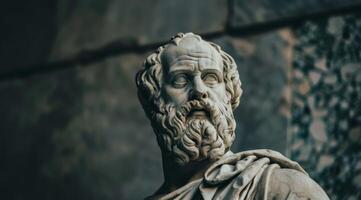
In entertainment and storytelling, Aristotle’s Poetics serves as the foundational text for Hollywood screenwriting masterclasses, narrative design in triple-A video games, and dramatic television structure. Modern directors, playwrights, and content creators rely daily on his three-act narrative principles, character arcs, and cathartic resolution mechanics. His physical likeness, immortalized in Roman marble copies of Lysippus’s original bronze bust, remains an iconic symbol of wisdom, academic excellence, and Western intellectual heritage across literature, museums, and digital media.
Monuments of Intellect: Universal Commemorations and the Surviving Manuscripts of Aristotle (Ἀριστοτέλης)
Over 2,300 years after his death in 322 BC, the ‘Aristotle project’ remains very much alive in contemporary research, archaeological discovery, and modern science. Scholars at international research institutions continually analyze surviving fragments, digital palimpsests, and newly translated medieval manuscripts to uncover lost Aristotelian dialogues. Recent archaeological digs in Ancient Stagira have unveiled his monument and tomb, revitalizing historical tourism and international scholarly symposiums dedicated to his life.
Furthermore, cutting-edge disciplines such as Artificial Intelligence, machine learning logic, cognitive science, and modern virtue ethics are undergoing an Aristotelian renaissance. Computer scientists and AI ethicists routinely draw upon Aristotelian categorical logic and teleological frameworks to program ethical decision-making algorithms and natural language processing models. As humanity navigates the complex ethical and technological frontiers of the 21st century, Aristotle’s foundational quest to define truth, virtue, and human purpose remains as urgently relevant today as it was in the colonnades of the ancient Lyceum.
Aristotle (Ἀριστοτέλης) FAQs: Key Questions Answered
How old was Aristotle when he died?
Aristotle died in 322 BC at approximately 62 years of age in Chalcis, Euboea, Greece, due to a severe stomach ailment.
Who was Aristotle married to?
Aristotle was married to Pythias, with whom he had a daughter named Pythias. Following her death, he lived with Herpyllis of Stagira, who bore him a son named Nicomachus.
What is Aristotle’s most famous work?
Aristotle produced foundational works across multiple disciplines, but his most famous treatises include Nicomachean Ethics, Politics, Poetics, Physics, and Metaphysics.
Did Aristotle really tutor Alexander the Great?
Yes. In 343 BC, King Philip II of Macedon hired Aristotle to tutor his 13-year-old son Alexander (later Alexander the Great) at Mieza, instructing him in rhetoric, literature, science, and medicine.