1. Grassroots Origins, Physical Gift & Formative Athletic Years
Andre Kirk Agassi was born on April 29, 1970, in Las Vegas, Nevada, into a household where athletic excellence was not merely encouraged—it was demanded with ferocious intensity. His father, Emmanuel “Mike” Agassi, was a former Olympic boxer who had represented Iran in the 1948 and 1952 Summer Games before emigrating to the United States. Mike Agassi brought a fighter’s obsessive mentality to raising his children, determined to mold a world-class tennis champion. In the backyard of their Las Vegas home, Mike constructed a customized, high-powered ball machine nicknamed “The Dragon.” The machine was modified to spit out thousands of tennis balls daily at rapid-fire speeds, forcing young Andre to hit over 2,500 balls every single day. This rigorous, unrelenting regime instilled in Andre an uncanny eye-hand coordination and reaction time that would later make him the greatest serve returner in tennis history.
Despite his undeniable natural giftedness, Andre’s childhood was characterized by psychological tension and intense isolation. The relentless pressure imposed by his father created a deeply conflicted relationship with the sport—a theme that would haunt Agassi throughout his early adult life. At just thirteen years old, Andre was sent to Bradenton, Florida, to enroll at the prestigious Nick Bollettieri Tennis Academy. Originally intended for a brief three-month stay, Bollettieri was so astounded by Agassi’s raw talent that he refused to take tuition, insisting the prodigy stay free of charge. In the high-pressure, competitive environment of the academy, Agassi honed his devastating baseline strokes, but he also rebelled against rigid structure. Piercing his ears, wearing ripped denim shorts, and sporting a wild hairstyle, the young Nevadan began cultivating the rebellious persona that would soon take the global sports landscape by storm.
2. Stepping into the Arena: Early Career Milestones & Rising Stardom
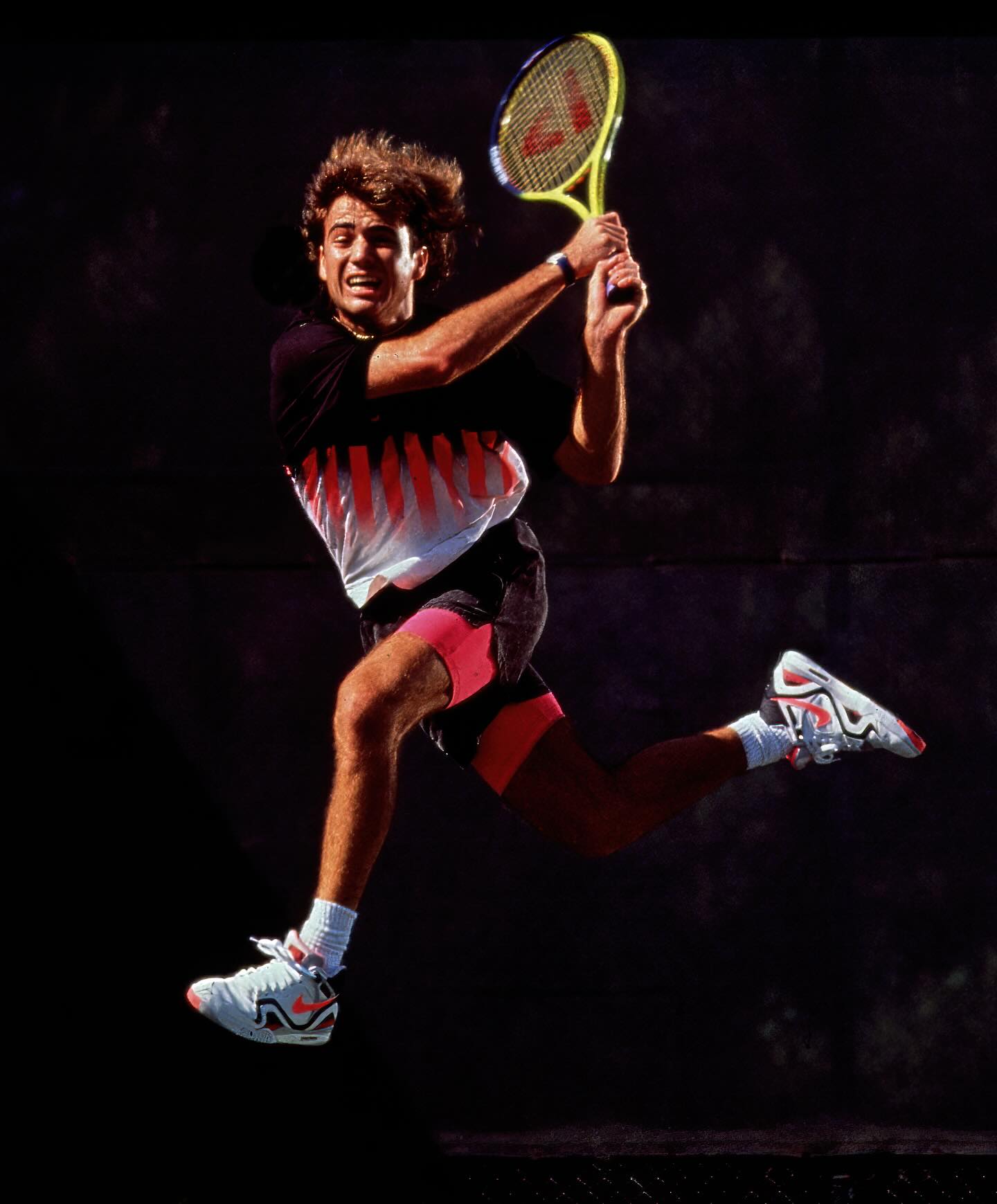
Andre Agassi turned professional in 1986 at the age of sixteen, entering an era dominated by classical tennis traditions and stoic personalities. His arrival on the ATP Tour was nothing short of a cultural shockwave. With his long, lion-like hair, neon-colored Lycra outfits, denim shorts, and an explosive baseline attack, Agassi disrupted the sport’s conservative aesthetic. He claimed his first ATP singles title in November 1987 at the Sul American Open in Itaparica, Brazil, finishing the year ranked World No. 25. By 1988, Agassi produced a sensational breakout season, winning six tournaments—including Memphis, US Clay Court Championships, Forest Hills, Stuttgart, Volvo International, and Livingston—and reaching the semifinals at both the French Open and the US Open.
By late 1988, having surpassed $1 million in career prize money faster than any player in history, Agassi had climbed to World No. 3. Beyond the impressive match metrics, Agassi became a pop-culture phenomenon. Endorsement deals flooded in, most notably a lucrative campaign with Canon featuring the iconic tagline, “Image is Everything.” That slogan would define Agassi’s early career, acting as both a marketing triumph and a psychological anchor that haunted his athletic identity. Tennis fans around the world flocked to arenas to witness his electrifying style, cementing his transition from a promising teenage prodigy to an international superstar.
3. Career Longevity, Historic Tournaments & Unmatched Dominance
3.1. Clutch Tournament Plays & Gold Medal Triumphs
Despite his early commercial dominance and rapid rise through the world rankings, Agassi faced significant critical backlash regarding his performance in major championship finals. Skeptics questioned whether his flashy style possessed the mental fortitude required to win a Grand Slam title. He reached his first Grand Slam final at the 1990 French Open, entering as the heavy favorite against veteran Andrés Gómez, but suffered a shocking defeat in four sets. Months later, he reached the final of the 1990 US Open, only to be overwhelmed by his arch-rival Pete Sampras in straight sets, an encounter that sparked one of the greatest rivalries in sports history.
Agassi suffered another grueling heartbreak at the 1991 French Open, losing a five-set final to his former academy roommate Jim Courier. Having boycotted Wimbledon from 1988 to 1990 due to his aversion to the tournament’s strict all-white dress code, Agassi returned to the All England Club in 1991 and again in 1992. It was at Wimbledon in 1992—the venue least expected to suit his baseline game—that Agassi achieved his ultimate Grand Slam breakthrough. Battling through a grueling draw, he defeated heavy hitters Boris Becker and John McEnroe en route to the final. On July 5, 1992, in a dramatic five-set showdown against big-serving Goran Ivanišević, Agassi collapsed onto the grass in tears after capturing his first Grand Slam title. The victory silenced critics and established Agassi as a major force capable of performing at the pinnacle of the sport.

3.2. International Stature & Dominance on the World Stage
The mid-1990s marked a period of immense athletic achievement for Agassi. Under the guidance of coach Brad Gilbert, who authored the famous strategy book Winning Ugly, Agassi overhauled his tactical approach. Gilbert urged him to tone down high-risk shot-making and utilize his world-class return of serve to systematically dismantle opponents. The strategy paid immediate dividends. Entering the 1994 US Open unseeded after recovering from wrist surgery, Agassi produced a masterful tournament, beating Michael Stich in the final to become the first unseeded player in the open era to win the US Open.
Agassi carried this momentum into 1995, capturing his first Australian Open title on his very first appearance in Melbourne by defeating Pete Sampras in a thrilling four-set final. Following a dazzling spring campaign that included titles in San Jose, Miami, and Washington, Agassi officially ascended to the World No. 1 ranking on April 10, 1995. He maintained the top ranking for 30 consecutive weeks, winning 73 out of 82 matches during a dominant season. In 1996, Agassi represented the United States at the Atlanta Olympic Games, capturing the Men’s Singles Gold Medal with a convincing victory over Sergi Bruguera in front of a home crowd.

3.3. Sporting Longevity, Trophies & Peer Recognition
After enduring a profound personal and professional slump in 1997, Agassi engineered the most dramatic career resurrection in tennis history. Shedding his artificial hairpiece, shaving his head, and committing to an extraordinary physical conditioning program led by trainer Gil Reyes, Agassi returned to the ATP Challenger Tour to rebuild his ranking from World No. 141. By 1998, he had surged back into the top 10. The crowning moment of his career evolution came at the 1999 French Open. Coming back from two sets down against Andrei Medvedev in a rain-delayed final, Agassi captured the Roland Garros crown. In doing so, he became only the fifth man in history—and the first on three distinct court surfaces (hard, clay, grass)—to complete the coveted Career Grand Slam. Coupled with his 1996 Olympic Gold, he became the first male player to complete the Career Golden Slam.
Agassi capped off 1999 by capturing his second US Open title, defeating Todd Martin in five sets, and finishing the year as the World No. 1 for the first time in his career. Over the next four years, Agassi dominated the Australian Open, winning titles in 2000, 2001, and 2003 to earn four Australian Open crowns. In April 2003, at age 33, he became the oldest man ever to hold the ATP World No. 1 ranking, a record he held for years. Agassi officially retired at the 2006 US Open at age 36 after a tearful, emotional farewell following his third-round match against Benjamin Becker. His career record stands at 870 wins, 60 ATP singles titles, 8 Grand Slam titles, and 101 weeks at World No. 1. He was inducted into the International Tennis Hall of Fame in 2011.
4. Behind the Champion: Private Passions, Relationships & Family Ties
Andre Agassi’s personal life has consistently generated global headlines, reflecting a journey marked by high-profile celebrity romance, emotional introspection, and lasting marital stability. In the early 1990s, Agassi’s jet-setting lifestyle saw him linked to global icons, including music superstar Barbra Streisand. Their close friendship and brief romance in 1992 drew intense tabloid scrutiny due to their 28-year age gap, though Agassi consistently praised Streisand’s intelligence and emotional depth.
In 1993, Agassi began dating Hollywood actress Brooke Shields. The couple became one of the defining celebrity pairs of the decade, featuring prominently in global fashion magazines and high-society events. They married in an extravagant ceremony in Monterey, California, in April 1997. However, the marriage coincided with the darkest phase of Agassi’s tennis career and was burdened by incompatible schedules and mutual emotional isolation. The couple divorced amicably in 1999 after less than two years of marriage.
Following his French Open victory in 1999, Agassi began pursuing fellow tennis legend Steffi Graf, whom he had long admired from afar. Graf, a 22-time Grand Slam champion, shared Agassi’s deep understanding of the immense pressures of professional sports. The two sports titans married in a private, quiet ceremony at their Las Vegas home on October 22, 2001. The union produced two children: a son, Jaden Gil Agassi (born October 2001), who grew up to become a talent in collegiate baseball, and a daughter, Jazz Elle Agassi (born October 2003). Unlike many celebrity couples, Agassi and Graf have maintained an extraordinarily private, grounded domestic life in Las Vegas, focusing heavily on family, community work, and educational philanthropy.

5. Career-Threatening Injuries, Sporting Feuds & Overcoming Adversity
5.1. The 1997 Drug Testing Controversy & Andre Kirk Agassi’s Confessions in Open
The defining scandal of Andre Agassi’s career occurred during his tumultuous 1997 season—a period when his marriage was deteriorating, his motivation had vanished, and his ranking plummeted to World No. 141. In his brutally candid 2009 autobiography, Open, Agassi shocked the global sports community by revealing that he had used methamphetamine (crystal meth) in 1997. Introduced to the substance by his assistant, Agassi ingested the drug during a period of deep emotional distress and career confusion.
Later that year, Agassi was notified by the Association of Tennis Professionals (ATP) that he had failed a drug test, testing positive for a Class II substance. Facing a mandatory three-month suspension for drug usage—which would have ruined his reputation and commercial sponsorships—Agassi wrote a deceptive letter to the ATP governing body. In the letter, he claimed that he had accidentally ingested the drug by drinking from a soda glass spiked by his assistant. The ATP accepted his explanation, dropped the case, and kept the failed drug test confidential. When Agassi exposed this cover-up twelve years later in Open, it triggered a massive media storm. Figures across the sporting world, including rival players and anti-doping officials, criticized both Agassi for his dishonesty and the ATP for shielding a superstar from punishment.
5.2. Nike’s "Image is Everything" Campaign & Andre Kirk Agassi’s 1990 French Open Wig Crisis
Throughout the late 1980s and early 1990s, Agassi was fiercely criticized by traditionalists for prioritizing image and commercial gain over competitive substance. His boycott of Wimbledon due to the all-white dress requirement drew public outrage, earning him a reputation as an arrogant, spoiled brat. The media seized upon his Canon commercial tagline “Image is Everything,” using it as a weapon whenever he lost high-profile matches. Critics argued that Agassi was a product of corporate marketing rather than a true sporting champion.
In Open, Agassi also made a startling revelation regarding his iconic 1990s hair: his famous long mane was actually a hairpiece designed to conceal premature baldness. Before playing the 1990 French Open final against Andrés Gómez, Agassi’s hairpiece began disintegrating. Terrified that the toupee would fall off in front of millions of television viewers, Agassi spent the night before the final holding it together with bobby pins. During the match, he was so distracted by the fear of public embarrassment that he played cautiously, ultimately losing the final. Shedding the hairpiece in 1995 and revealing a shaved head became an extraordinary moment of personal liberation, transforming him from an image-obsessed performer into a mature, focused champion.

6. Nutrition, Brand Ambassadorships & Sporting Influence
Andre Agassi’s impact on popular culture extends far beyond his eight Grand Slam titles. In the late 1980s and early 1990s, he single-handedly revolutionized tennis fashion, dismantling the rigid, aristocratic white-shirt aesthetic that had dominated the sport for over a century. His signature Nike Air Tech Challenge sneakers, neon pink spandex compression shorts, acid-wash denim skirts, and bandanas defined a youth movement. Agassi transformed tennis courts into runway stages, inspiring millions of teenagers worldwide to pick up tennis rackets.
Though Agassi grew up long before the era of modern digital media, he maintains an active and authentic presence across social platforms including Instagram, X (formerly Twitter), and Facebook. His social footprint focuses primarily on his philanthropic endeavors, family life with Steffi Graf, pickleball exhibitions, and youth development. Agassi’s willingness to display vulnerability—exemplified by his groundbreaking memoir—redefined how elite athletes approach public disclosure, paving the way for modern discussions surrounding mental health, parental pressure, and athlete identity in professional sports.
7. Current Season Campaigns, Title Defense & Future Ambitions
Since retiring from professional competition, Andre Agassi has transitioned into a highly respected business leader, educational philanthropist, and sports investor. His primary life passion is the Andre Agassi Foundation for Education, established in 1994. The foundation raised tens of millions of dollars to build the Andre Agassi College Preparatory Academy in Las Vegas—a tuition-free charter school dedicated to providing top-tier education to underserved and at-risk youth. Furthermore, Agassi partnered with investment funds to establish charter school facilities across the United States, providing modern educational infrastructure to tens of thousands of students.
In addition to his educational initiatives, Agassi briefly returned to elite tennis coaching, working with 24-time Grand Slam champion Novak Djokovic from 2017 to 2018 and Bulgarian star Grigor Dimitrov from 2018 to 2020. In recent years, Agassi has embraced the booming sport of pickleball, participating in high-profile televised exhibition matches alongside legends like John McEnroe, Andy Roddick, and Steffi Graf. Through Agassi Graf Holdings, he and Graf continue to invest in hospitality, sports technology, and wellness ventures, ensuring that Agassi’s cultural and economic footprint remains as dynamic today as it was during his playing career.
Andre Kirk Agassi FAQs: Key Questions Answered
How old is Andre Agassi?
Andre Agassi was born on April 29, 1970. As of 2026, he is 56 years old.
Who is Andre Agassi married to?
Andre Agassi has been married to 22-time Grand Slam tennis legend Steffi Graf since October 22, 2001. He was previously married to actress Brooke Shields from 1997 to 1999.
How many Grand Slam titles did Andre Agassi win?
Andre Agassi won 8 Grand Slam singles titles during his career: 4 Australian Opens (1995, 2000, 2001, 2003), 2 US Opens (1994, 1999), 1 French Open (1999), and 1 Wimbledon (1992). He also won the Olympic Gold Medal in 1996.
What is Andre Agassi’s most famous achievement?
Agassi is best known for completing the Career Golden Slam—winning all four Grand Slam tournaments and an Olympic Gold Medal in singles. He was the first male player in history to complete the Career Grand Slam across three different court surfaces (hard, clay, and grass).


